Page 14 - Batteries
-
- June 09, 2011
We’ve been talking about various battery news and the products we have featured at Impact Battery to keep you powered up with your battery needs. But we sell more than a variety of high-quality batteries for your laptop, scooter, boat, RV, solar needs, wheelchair, toys and more. We also sell battery chargers and even power inverters.
Power inverters convert DC voltage provided by a 12, 24 or 48 volt battery into AC current, which is similar to the current provided through your typical household electrical outlet. We sell both modified and pure sine wave inverters along with DC to DC converters in a variety of performance strengths to meet your needs.
If you’re not sure about inverters, why you may need them, and which performance strength you may need, our website features comprehensive product information to help make your buying decision easier. Not only do we feature the product we are selling with a zoom so you can really examine it more closely, we offer detailed product features,
-
- June 02, 2011
With so many reasons for batteries to power up our various equipment, toys, solar panels, and more, it may be prudent to carefully consider a quality battery charger to ensure you are getting the recharge you should. After all, it can sometimes be the charger you are using rather than the battery itself that needs to have its performance assessed.
At Impact Battery, we offer “smart chargers,” meaning they are microprocessor controlled. We feature an impressive selection of 12-volt and 24-volt chargers. In addition, we stock 36-volt and 48-volt golf cart, RV, and waterproof Marine chargers.
With summer activities about to swing into high gear, now is the time to consider a high-quality charger for your golf cart, boat, RV, scooter, motorcycle, or other equipment you may be utilizing more regularly than you have in previous months.
We sell top-quality brands like Battery Tender, Dual Pro, Samlex, CTEK, Genius, Quick Charge and Schauer, among others. To make it easier for your to search for
-
- May 26, 2011
Nintendo’s 3DS portable gaming system has only been available in the U.S. for a short time, but it has already sold more than a million units. The 3DS is the first commercial device with a glasses-free 3-D screen and kids, teens and adult gamers alike are flocking to the new device.
But while they love the 3-D illusions, Science Daily is reporting that its three-hour battery life is less than half of its predecessor, the 2-D DS device, which may make some gamers quite unhappy with decreased play time.
But that may change soon, due to some innovative researchers at the Massachusetts Institute of Technology. They have developed a fundamentally new approach to glasses-free 3-D called HR3D, which they say will double the battery life of devices without compromising screen brightness or resolution. The technique is claiming to also expand the viewing angle of a 3-D screen, which could pave the way to larger devices with multiple users while maintaining the 3-D effect.
Why are we putting this
-
- May 19, 2011
The idea of no more gas cans and quiet mowing with an easier start are some of the top reasons why more and more families are turning to the idea of battery-powered lawnmowers and lawn equipment this year. While early models of battery powered mowers may not have had the power or charge time consumers wanted, that is no longer the case.
Improved designs and better battery technology means that battery mowers can provide the powerful performance to navigate through a variety of grass conditions and have the power needed to get the job done.
In addition, there is no gas or oil to spill and no engine emissions to pollute the air.
Battery types vary by models so you’ll want to check out what type of battery is used before you choose a battery-powered mower. Most mower styles feature removable, rechargeable batteries that are ideal for lawns up to 1/3 acre on a single charge. For larger lawns, consider buying an optional spare battery so your mowing won’t be interrupted.
Take a look at this
-
- May 12, 2011
Researchers have shown that ozone can be reduced when electric vehicle charging is done at night. That’s good news for both environmentalists as well as car owners of plug-in hybrid electric vehicles, who typically choose to charge cars in the evening when drivers are more apt to be at home.
Ozone is a known pollutant that can cause harmful effects on certain individuals with respiratory ailments. It forms as hydrocarbons and nitrogen oxides, emitted into the air, react with sunlight. Two of the largest emitters of these pollutants are vehicles and electricity generating units.
Charging plug-in hybrid electric vehicles, also known as PHEVs, is already known to be more cost effective and reliable. But a new report issued by researchers at the Massachusetts Institute of Technology and the University of Texas have found that charging at this time leads to lower levels of pollution on average.
PHEVs have the capability to run off battery power and gasoline. When PHEVs run off battery power
-
- May 09, 2011
[caption id="attachment_324" align="alignright" width="264" caption="MP3450 Tekkeon Portable Battery"][/caption]
The Tekkeon portable battery packs have arrived at Impact Battery! These lightweight lithium polymer batteries can be used to power a multitude of gadgets including, cell phones, laptops, PDA's, portable DVD players, iPhone, iPad, hand held gaming systems--the list goes on. They are versatile rechargeable units that draw power from the included AC adapter and DC power sources such as the cigarette lighter adapter in vehicles and solar panels. The output voltage ranges from 5V (USB portal) to 19V. At 6.85" (L) x 3.32" (W) x .89" (D) and less than 1 lb these external batteries can easily fit into your carry-on bag and are approved for air travel. The MP3450, for example, can power a laptop about 4hrs and power your cell phone at the same time. When the 2nd extended battery is attached you can effectively double your output.
The most compelling argument for these
-
- May 05, 2011
If you’ve popped your hood and taken a close look at your car’s sealed lead acid battery lately, chances are you’ve noticed a build-up (unless your battery is new) of corrosion caused by acid condensation. The crusty-looking whitish or greenish appearance is actually easy to clean, and most likely you already have everything you need. But while it is easy enough to accomplish, you’ll need to make sure you keep safety protocols in mind so that you don’t hurt yourself—or your car—in the process.
While some batteries may be so corroded that they require disconnection of the cable clamps or terminals, we’re not recommending that and instead talking about general maintenance and cleaning that you can do while keeping your car’s battery still in place. A severely corroded battery may require additional maintenance and cleaning beyond what we are discussing here today.
Supplies:
- Safety goggles/protective glasses
- Box of baking soda
- An old toothbrush or similar bristled brush
- Cleaning rags or sponges
-
- April 28, 2011
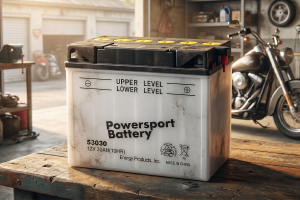
Why is it that batteries to motorcycles, ATVs and even boats don’t seem to last? This is a very common complaint we hear, and one of the most obvious culprits seems to be sporadic use of the battery. Many pleasure boaters, for example, haven’t even taken their boat out since the last days of summer last year. Yet they get into the boat when warm weather arrives and are seemingly surprised that their battery isn’t quite as ready for boating action as the passengers.
Batteries will discharge at a rate of approximately 2-5 percent each month while not being used. While use does indeed keep a battery operating at peak capacity more consistently, a low battery can’t be fully charged by simply being cranked up on occasion—no matter the distance or length of time.
If a motorcycle or equipment is not going to be used for a period of 30 days or longer, consider placing the battery on a 2 amp or less smart maintenance charger for 24-48 hours every month (even better leave it connected indefinitely).
-
- April 21, 2011
Sulfation is the buildup of lead sulfate crystals on a battery’s plates, usually in lead-acid batteries. It happens when a battery stays discharged too long, is undercharged, or is repeatedly used without proper recharging. Sulfation reduces the battery’s ability to hold and deliver power.
When sulfation builds up, the battery charges slower, loses capacity, and may struggle to start engines or power devices. Over time, the crystals harden and block the chemical reaction needed for normal battery performance.
Mild sulfation can sometimes be reduced with proper charging or a smart charger’s desulfation mode. Severe sulfation is often permanent and usually means the battery needs replacement. The best prevention is keeping the battery fully charged, avoiding deep discharge, and using a maintainer during long storage.
What is Sulfation and How Does it Affect My Battery?
Why do batteries get old and fail, and is there any way to avoid this? While it would be amazing to have a battery that
-
- April 14, 2011
It’s far from being on the marketplace, but Science News is reporting that a battery is being tested with a three-dimensional nano-structure for battery cathodes that allows for dramatically faster charging and discharging without sacrificing energy storage capacity.
Batteries that can store significant energy and release it fast and then recharge quickly are desirable for the up-and-coming electric vehicles. In addition, they are sought after in the medical field for equipment, lasers and in military applications.
The performance of traditional lithium-ion (Li-ion) or nickel metal hydride (NiMH) rechargeable batteries degrades significantly when they are rapidly charged or discharged. Making the active material in the battery a thin film allows for very fast charging and discharging, but reduces the capacity to nearly zero because the active material lacks volume to store energy.
The test design essentially wraps a thin film into three-dimensional structure, achieving both high active