Page 2 - Tips
-
- August 29, 2012
There are many battery-recycling solutions available to the public. In everyday life, it can be easy to overlook the problem caused by not recycling batteries. For example, just imagine how many cell phones Americans will go through in the next few years. Most of the time, those used cell phones will end up in trashcans and make their way to landfills without being properly disposed. This is a problem because of the hazards that decaying batteries can pose to our environment. As a consumer, it is important to take advantage of the convenient, and often free, battery-recycling programs available.
In 1996, a non-profit battery recycling program called, Call2Recyle was established as the only free battery-recycling program in North America and since then has recycled over 70 million pounds of batteries in an effort to remove batteries from landfills and reduce pollution caused by the improper disposal of batteries. The way it works is quite simple; collection sites associated with the Call2Recycle
-
- August 15, 2012
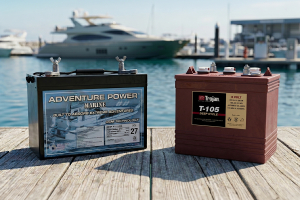
If your boat batteries are properly maintained, you will be able to enjoy them for five to seven years! Some people use their motor boats far more often than others, and generally, those who do have batteries last longer. In order to prevent unnecessary wear and tear on your engine and electrical system, you should start and run your boat regularly to maintain proper lubrication of engine parts and charge of your battery.
Boat batteries will power things like bilge pumps, lights, and sound systems. They are also different than car batteries. We strongly recommend that you use deep cycle marine batteries for your motor boats. Take extra caution if you keep your boat on salt water as exposure to salt water will accelerate corrosion of metal parts.
Some maintenance tips:
- (1) If you store your boat in a region with cold winters, remove your battery and store at home in a dry location.
- (2) Do not place your battery directly on the ground or floor. Doing this may provide the battery with a grounding
-
- April 17, 2012
Dead Batteries...The Joy of Children
It was my turn to take my son to school today. As we prepared to get in our red Subaru Legacy my son asks, "Dad, did you charge the battery yet?" I had completely forgotten to do so. The battery went dead the prior week after our youngest daughter found an unlocked door and managed to flip every switch, turn every dial, and twist every lever. Needless to say, the lights and everything else that draws power were left on without us noticing.
I had a PulseTech Xtreme charger in the garage and connected it to the terminals. Nothing. The charger indicated it was connected to AC power and that it was not connected to a battery. Of course, being the 'smart' man that I am, I figured the charger was wrong or at the very least the clamps slipped off. So I held the clamps directly on the auto post avoiding any corrosion
-
- October 13, 2011
A battery not achieving or holding a desired charge is a common complaint with consumers for anything electronic. Whether it is a battery for a toy, scooter, golf cart, boat, RV, laptop, or a hose of other electronics items, customers rightfully expect for their battery to produce a charge that makes the equipment is for run.
We have discussed previously that batteries have a life and that no battery—regardless of the brand or quality—lasts forever. But sometimes, consumers unwittingly shorten their battery’s life by using the battery improperly. When that happens, the end result could be a battery that is damaged, and in some cases, could even affect the appliance or equipment itself.
Common reasons why batteries fail:
- A battery is exposed to extreme weather conditions—heat, cold or moisture.
- Battery is attempted to be used in a different way than what it was made for. Many batteries are designed for a specific product and using them interchangeably when they shouldn’t be can cause damage.
-
- September 15, 2011
Selling batteries is what we do, but when we saw the article this week from Techlicious about potential techie products that are possible dangers to children, we wanted to pass it on to our families.
Topping No. 4 on the hazards list is "button cell batteries", touted as potential poison pills. Since 1985, there have been 3,500 injuries and nine deaths. These small button-sized batteries are commonly used in items like remote controls, toys, light-up shoes, digital ear thermometers, and countless other products.
The danger here According to the National Capital Poison Center in Washington, D.C., is that children, usually toddler-age, swallow these batteries. The batteries can get stuck in children’s throats. This is obviously a choking hazard but more often overlooked is the potential for severe chemical burns. "The effect starts within minutes of ingesting the battery and in as soon as two hours can burn a hole through the esophagus where it's lodged," says Dr. Toby Litovitz, executive
-
- September 08, 2011
Labor Day is the traditional end to summer. And while there is still ample time to enjoy warm weather sports and activities across much of the country, thoughts are already turning to cooler temperatures and new activities it will bring.
If you are a fair weather boater and don’t plan to use your boat once cooler temperatures make their debut, it’s important to make the proper preparations for storing your battery so that it will serve you well when boating season returns.
While the preparations make take some time and effort, it’s much better than having to buy a new battery when you are ready to bring your boat out again next springtime.
Here are the basic steps in boat battery storage:
- Remove the caps off the top of wet cell batteries and check the water level in each cell. Add distilled water so that the level is full in every cell, and then replace the caps.
- Test your battery to make sure it is fully charged. If not, put it on the charger until it is fully charged.
- Clean and dry the
-
- August 18, 2011
You may have a UPS power source, even though you may not instantly be familiar with the name. UPS stands for uninterruptible power supply, and the battery-powered units are intended to provide emergency power to a load when the input power source fails.
While UPS power supplies are not limited to a particular style or type of equipment, they are most commonly used by consumers to protect computers. With companies, it may be for computers, data centers, telecommunication equipment or other electrical equipment where a sudden, unexpected surge or power disruption could cause a loss of data, business disruption, or even threaten personal safety. Sizes of UPS units vary so they can provide the needed backup ranging from individuals to a business, building or even city. Needless to say, maintaining the battery for these units is critical in the event that the UPS is required.
At Impact Battery, we offer a selection of AGM sealed lead acid UPS batteries manufactured by Amstron and Universal
-
- August 09, 2011
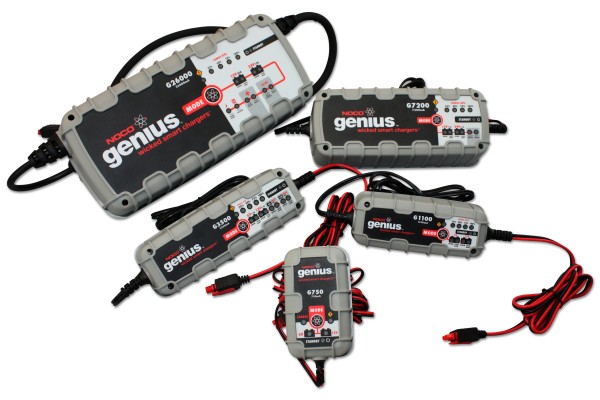
[caption id="attachment_40" align="alignleft" width="300" caption="Smart Genius Chargers"][/caption]Customers frequently ask, "Why do I need a charger?" Rather than replying sarcastically, "Why do we need to eat healthy and exercise?" I choose to provide a little education that will hopefully help save our customers money and frustration in the future.
Lead acid batteries will self discharge when left sitting unused. Discharged batteries rapidly undergo a process called sulfation. You see, when batteries are discharged the active lead material bonds with the sulfate and electrolyte forming sulfate crystals. These sulfate crystals harden and block the effective area of the battery and reduce its capacity. A battery with no capacity is useless; it can't provide the power required for its designated function. A smart battery charger, such as the Noco Genius brand of chargers, will help prevent sulfation from occurring by keeping your battery in a constant state of charge. They will never
-
- August 04, 2011
If you’re preparing to send you child off to college—whether it is for the first time or to begin a new year---there are certain items you’ll want to include in your care packages so your child will be better prepared for the school year.
Here are top battery accessories to go along with essentials most college students will either want or have for their higher education. Providing your child with these sometimes-overlooked equipment items now may mean an avoidance of those late-night phone calls and pleas for assistance later.
- Laptop accessories. A laptop is no longer a luxury item for college students. It is now an essential, and a growing number of colleges even require it for the school year. As more and more colleges go paperless, it is essential for students to get their notes, take notes, look up assignments, and even take their tests online. To avoid the problem of having a battery run out of life in the middle of a note-taking session, or worse, an exam, most parents provide their
-
- July 30, 2011
Follow this link to view or purchase flexible or portable solar panels, otherwise enjoy the blog article.
[caption id="attachment_468" align="alignleft" width="300" caption="Bolan Peak Fire Lookout"][/caption]
This past weekend (July 22-24, 2011) I had the pleasure of taking my oldest son into the Siskiyou mountains of Southern Oregon and Northern California for some father/son time. We stayed in an old fire tower atop Bolan Peak nestled around 6200 ft amongst a handful of craggy peaks reaching around 7500 feet. The weather was perfect as we finally experienced summer like temperatures that had eluded us since last September. We knew this past winter produced heavy snows, but were still amazed and delighted to see large snow drifts and plenty of shady area snow pack, both quite unusual this late in the season at our elevation. Understandably, we spent our first morning hiking the ridge line south of the lookout tower sliding down the snow shoots and scurrying through the snow tunnels