
12000mAh Lithium Jump Starters: What is the Difference between Weego, Antigravity, Energen and others?
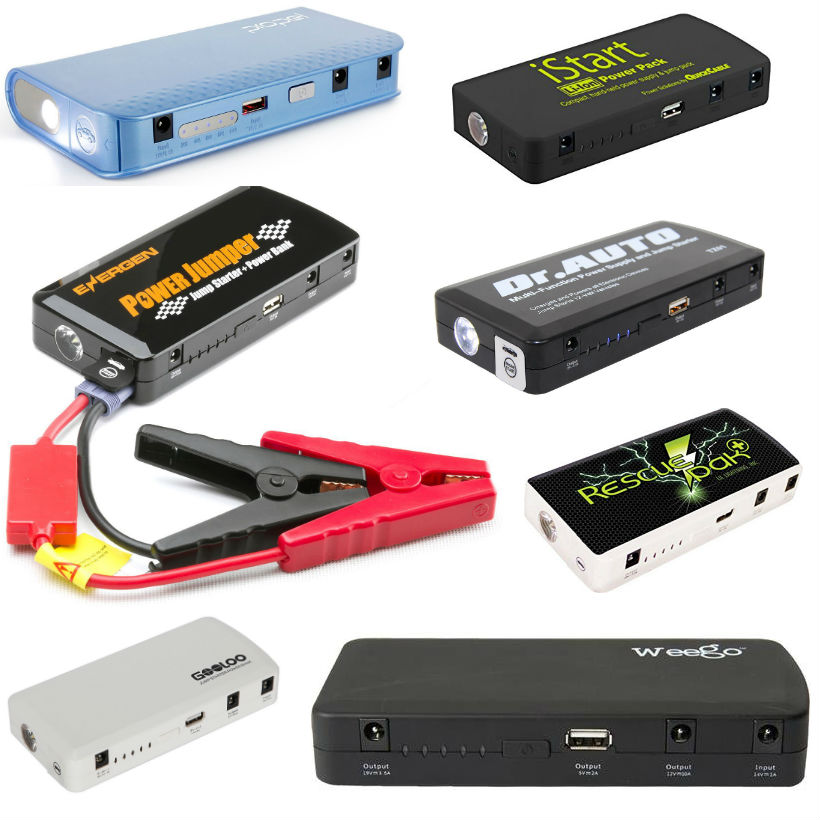 The short answer to this question is Components, Marketing, Price, Paint & Packaging! When comparing the various pocket-sized 12000mAh lithium jump starters such as the Antigravity Micro Start XP-1, Weego JS12, Lil Lightening RP-2, PowerAny 12000, GooLoo GP01, the Energen EN-PJX6, istart, Dr. Auto, Jump Tiger and CarKu one might notice they tend to appear eerily similar. This is because, for all sakes and purposes, from the outside looking in, they are! The basic design of the power bank used for all of these brands is identical less the paint scheme. If you expand your search beyond these brands you will find slight variations to this basic design and not much else to differentiate them. Most of the packaging is also identical, although some such as Energen, have made improvements in this area by introducing a more secure hard case with handle and saying goodbye to the annoying elastic straps and goofy looking soft sided carrying case.
Give Credit Where Credit Is Deserved
From what we can tell, Antigravity was one of the first players, if not the first company to usher us into this lightweight portable power jump starter craze. They have a solid lithium power sport battery franchise and it only seemed natural to expand upon that success. The Micro Start XP-1 easily bridged the gap between the seemingly mundane, but necessary battery market and the red hot consumer electronics market. We believe they were integral in kick-starting the demand for these Personal Power Supply jump starter gadgets and want to take a moment to say Well Done Antigravity!
Marketing of the 12000mAh Lithium Jump Starters
It is interesting to watch how the various brands of lithium jump starters are marketed. The Energen brand, not to be confused with the publicly traded oil & gas exploration company Energen (EGN), seems to be an up and coming portable power device manufacturer with a corporate website searching out distributors (such as Impact Battery) and listing on third party marketplaces such as Amazon. Weego has done a really good job on their myweego.com site promoting not only their JS12 “Heavy Duty” 12000mAh lithium jump starter, but their entire portable power lineup by using entertaining and educational videos. Some of the others appear to be nothing more than a trademarked name sold only on Amazon with no namesake website or known parent company. Others are private label brands brought to market under established companies such as Quick Cable and their iStart unit and Northern Tool and the Carku brand.
Paint & Packaging
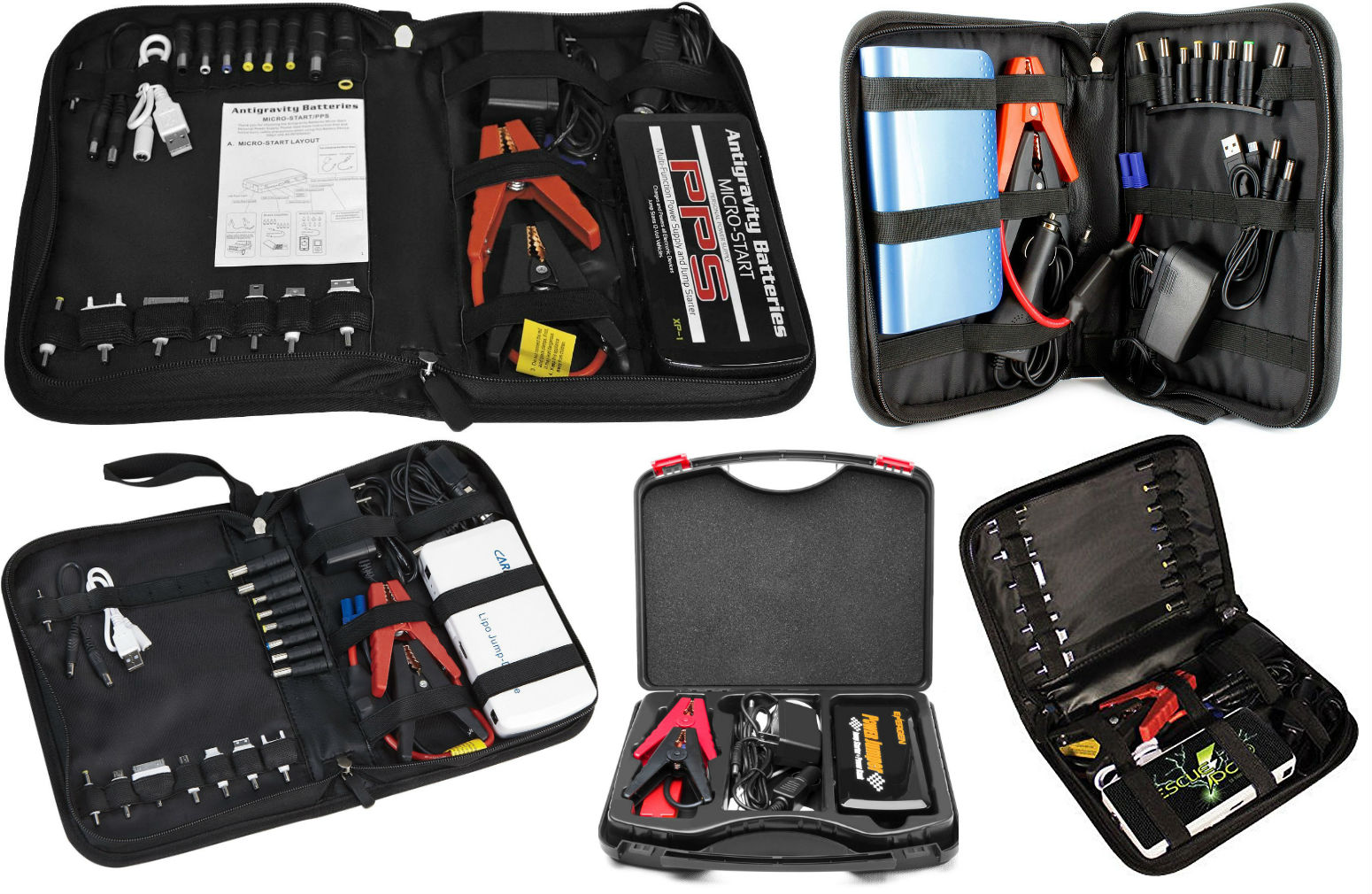 The packaging and paint scheme found on these portable power jump packs, at least on the surface, is the only distinguishable difference. And even then is easy to overlook. Even as I write this article the packaging is changing and new “me to” brands are hitting the market. Don’t be fooled by it or let it deter you from purchasing one these must have tools. There will be some improvements and some not so convenient changes. Personally, I thought the soft carry case was cheap feeling and the elastic bands used to hold everything in place incredibly annoying to work with. I really liked the hard case with handle and the sectioned compartments.
Price Matters
It seems pricing for these identical looking 12000mAh lithium jump starters are all over the map. Several entities have expressed their frustration with “knock offs,” as they call them, or “home-based-make-a-buck-or-two-selling-from-your-garage” small business owners that erode margin and dilute their profits. We have seen prices swing from as high as $289.99 to as low as $41.89. Not surprisingly, the so called “knock offs” tend to be the less expensive brands while the established pioneer type companies with some sort of marketing budget, real people and brand penetration will be higher. But what do you gain (or lose) by purchasing a higher priced unit compared to one that may be the cheapest? I think in part, you gain credibility and peace of mind. Should you have questions or concerns, more than likely someone will be available to talk with and resolve potential issues. The higher priced units may have longer warranties. The Energen EN-PJX6, for example, has a 2 year warranty while the Weego JS12 currently has an 18 month warranty. The fact that they are willing to provide an extended period of coverage indicates they believe in the quality of their device. Regardless the brand, these units are all made in China and the Chinese have a tendency to skimp on quality if the buyer demands lower pricing. With that in mind it is not a far stretch to think some of these lower priced units may have quality concerns or lack the personnel to handle customer care issues, especially if you cannot find any manufacturer info beyond the Amazon market place listing.
In our opinion, some brands warrant a slight price premium, but we do not think you ought to pay more than around $110 to $130 for a 12000mAh lithium jump Starter. If you can find one that is regularly priced a little higher on sale in this range or one normally in this price range for a little less, snatch the deal while you can! Check out our current deals on 12000mAh lithium jump starters and other portable power devices including the economical and trustworthy lead acid based jump packs.
Micro Start 12000mAh Jump Pack Components
Aside from finding the best price for your 12000mAh lithium jump starter, you have to consider what the long-term value will be. A great warranty and a reputable company will provide some peace of mind, but sometimes you have to lift the hood and kick the tires to truly appreciate and validate what you are buying! Marketing, price, paint and presentation can only take you so far. To address the internal differences between these units you will need to read PART II of what makes up the difference between these 12000 mAh Jump Starters. We are acquiring various units and testing them in real world scenarios to see how they stack up against each other and the manufacturer claims. Will the higher priced units perform better? Or will they simply be a more expensive option for the consumer? You may be surprised by what we discover!


The danger of lithium battery is real ,If load in a B Grade cells it may Happen bulge , More serious will produce explosive . and if an badly circuit board it may Damage mobile phone motherboard ,battery as well .
The whole of your products is very good,But the laptops charge ,Smart cable . As everyone knows, All of laptop battery voltage is 11.1V and All the jump starter on the market, although it was marked 19V/3.5A, But this is just a theory. The real 19V/19.5V is the AC 220V + laptop standard adapter.The adapter Voltage must be high than the laptop battery voltage , Otherwise
it can not charge. That` why the laptop battery voltage at 11.1V and the adapter voltage should be from 12V to 19.5V. When the jump starter charging the laptop , the jump starter voltage will drop, the laptops battery voltage will rise , Both of Them Voltage will be flat slowly .
So How your pic can do it ,And the weego ? the 19V/3.5A In your starter just a Laptops power bank . SO FAR , I have only seen a product or a manufacturer can do ,Perhaps the only one in the world as they own this tech and Patents .Those Jump starter Can be called“EMERGENCY ” , Those items can turn on the laptops when the laptops battery Dead/ Take down . BUT YOU CAN NOT .
If a perfect product is ten , i just give you 7, and they 9. In the same capacity of products, their products can be reached 600Amps ,But you only 400Amps peak current .
Second is the Battery cable , Your cables may have five-anti (Five kinds of protection)functions . But your cables under the Control of electrical appliances .This is just a “physical method” . But their clip own the same functions ,The different from you their used the IC Smart control , Just like a sick man ,One choice to take medicine and the other wait .
They're not famous, but you can find them at "impower mfg".com .Perhaps their technology has works for you .
This is Julianna Toscani of Weego Portable Power. It’s great
to see someone really dig into the major issues present in the lithium-ion jump
starter market – both you and Scott of Antigravity have made some really
important points in your comments.
As a company that puts a heavy emphasis on safety and
quality, Weego has put a ton of focus on bringing awareness to the dangers of low-cost
portable jump starters. We always say, “Good
batteries aren’t cheap, and cheap batteries aren’t good”. As Scott stated,
lithium-ion batteries are extremely dangerous when improperly manufactured – when
safety is in question, consumers need to ask: “Is the cheapest option really my
best bet?” Probably not!
There are a few companies who have really taken the time to
do their homework and get to know the inner-workings of their products. After
all, how can you figure out the safest way to use and improve your product, if
you never take the time to fully understand how it works in the first place? By
looking at a company’s website you get a good idea as to who’s an expert in
their product, and who just slapped a logo on the first jump starter they came
across. The guys who know their product likely
took time to do some extensive testing and research, and would have great
customer support to back it all up.
Perhaps the most important point Scott made is that even
though the jump starters may share the same mold, their insides are vastly
different. This is what makes or breaks the quality (i.e. the safety). There
are some manufacturers that specialize in the production of these jump
starters, and others who have no idea what they’re doing. The clueless
manufacturers saw a trend in portable jump starters and jumped on it, using the
same exact molds. They threw something together, and sold it to someone in the
U.S. who didn’t know any better (and maybe didn’t care to, either). This is how
you come across the ultra-cheap jump starters. This is also how you create a
future recall.
Some companies, like Weego, took the time to investigate and
audit their manufacturers to ensure they were getting a safe and reliable
product. Again, these companies are easily identified by their website content
and support. These are the companies that will earn the quality reputation, and
these are the companies you should put your money towards when buying a li-ion
jump starter.
Looking forward to part 2 and 3 of this series!
Julianna
Toscani
Weego Product Engineering Specialist
This is Scott Schafer of Antigravity Batteries. It's believe it's really great to put out a page to help customers make an informed decision. I don't know the level of research that you have done but there are some inherent differences between many of the units offered that are MUCH more than just the "paint" or as we call them the "Graphics" and the case. While one quality manufacture may supply 3 to 4 companies in the USA, there are about 20 other manufactures making duplicates of the popular models and selling them for much less and with seriously inferior components as you pointed to. This is how they achieve the extremely low price points. Just because the exterior case is the same does not mean all the units are the same.
There are a number of different considerations to take into account in this market, but the bottom line on a quality product is offering "A" grade lithium cells from a reputable company, and additionally, the circuit board design and components on the circuit board are vitally important. You cannot achieve the low level price point some of these companies offer without cutting the quality of the components. This is a primary reason why you can see such massive price differences in some units. Important factors such as insurance coverage on the product, and whether or not it is a real company who knows about the product and how it's made, or just a licensed name brand selling on Amazon. Anyone can order this product from China in low quantities now and not have insurance or testing behind the product. These units may look the same as a quality product that is already on the market. Many companies in China just make a similar mold and then buy their own low grade lithium cells and circuit boards, and sell it to many on Amazon or through a retailer on Amazon. If you try to find some of these companies to get hold of them for questions or get information you really can't. Usually, they will just be license a brand name, but the company's name they licensed knows nothing about the product itself, nor do they develop or understand lithium-ion batteries in general.
This product type became an extremely hot seller over the last year, but with that comes the companies that have no idea about lithium batteries and the manufacture and safety needs. These companies think they can just go and get a broker in China to produce the product and sell it. A perfect example is Walmart. After seeing the potential in selling this type of product, they went out thinking they could find a mini-jump starter and bring it in to sell. Even as one of the largest and most reputable companies in the world, they ordered a particular model from a certain company who has a reputation for selling "electronics", but are not familiar with Lithium-Ion battery manufacturing. Within 3 months they recalled all of their units. That being said, it is not so simple as putting a name on a product and reselling it, nor does it mean that because one company has an identical looking product that it has the same internals or safety components. Another example, and without wanting to bash the Energen product you mention, the fact it is does not have Smart Clamps with it that offer built-in protections from Reverse Polarity, Short-Circuit, Low Votage and other protections that Smart Clamps afford. So there are other variables to many of the product that look a like. The Energen looks just like our XP-1 but does not have the Smart Clamps and we know for fact is it a copy of the original XP-1 Design which unfortunately became a public mold in China a year ago and is a different manufacture for sure, but looks the same. Just pointing out the details of what I am expressing. They are not all the same though they look the same.
I am not saying that Antigravity Batteries is the only good model of this type of product, but rather I am trying to inform the consumer to be aware that this type of product should be purchased from a reputable company, with a reputation for a quality product, and knows the product inside and out. We see many outright lies portrayed on Amazon, such as the correct capacity or amp discharge capabilities of the products. They will claim twice to 3 times the actual capacity of the unit to portray their product in a better light. It really is a roll of the dice if you are not buying from a reputable company in this area. They should have phone numbers for the company and be able to answer all questions regarding this type of product. You should be able to find their brand name on the internet easily, and not just on an Amazon or eBay store. Lithium batteries are a hazardous and potential dangerous product if misused or manufactured incorrectly, and while this is a super-hot product at the moment, there are some extremely low quality units and they are not all created the same...so buyer should beware
Regards,
-Scott