MCA vs CCA Battery | What’s the Real Difference?
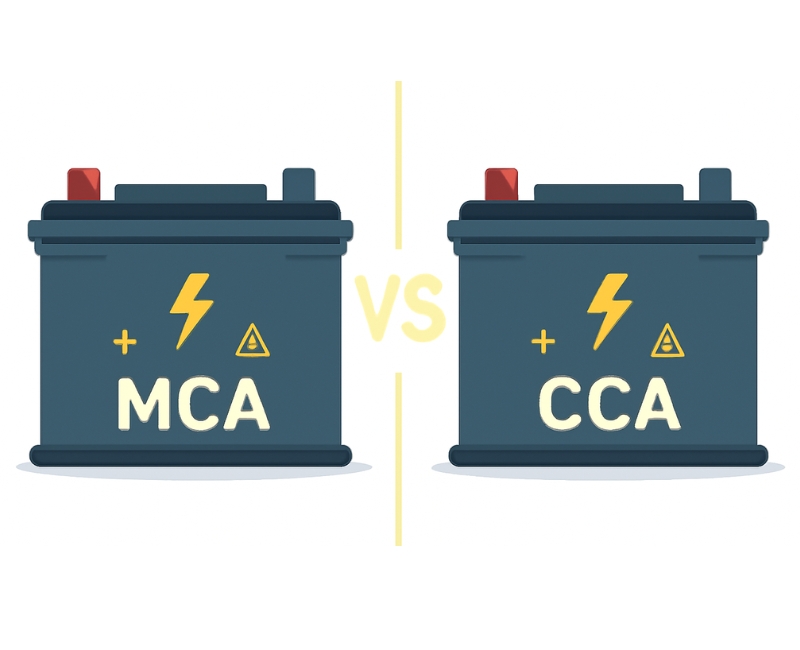
You’ve probably noticed two ratings on battery labels - MCA and CCA - and wondered what they actually mean. If you’re comparing a marine battery to an automotive one, those letters can be confusing.
MCA (Marine Cranking Amps) and CCA (Cold Cranking Amps) both measure how much current a battery can deliver to start an engine, but they’re tested under different conditions. One’s built for chilly mornings, the other for milder marine environments.
Think of it as the same athlete running two races - one in winter, one in spring - to prove endurance. In this guide, we’ll decode both ratings, show how they relate, and help you choose the right one for dependable power every time.
Understanding What a Cranking Amp Rating Measures
Every time you turn the key, your starter motor draws a powerful burst of electricity from the battery. That surge of current (amps), delivered over roughly 30 seconds, is what cranking amps measure. It tells you how much power the battery can push out while keeping voltage above 7.2 volts, the minimum needed to fire the engine.
Both MCA (Marine Cranking Amps) and CCA (Cold Cranking Amps) are tested under this same 30-second rule - the only difference is the temperature. As the temperature drops, internal resistance rises, making it harder for current to flow. That’s why cold-weather ratings matter so much for cars.
These measurements aren’t random; they’re defined by SAE J537 and BCI testing standards, ensuring batteries are judged by performance, not guesswork.
A battery isn’t rated by luck - it’s rated by how much current it can push before voltage collapses.
What Is CCA? Cold Cranking Amps Explained
When winter hits and your engine hesitates before starting, that’s when CCA (Cold Cranking Amps) really proves its worth. CCA measures how much current (amps) a fully charged battery can deliver for 30 seconds at 0°F (-18°C) while keeping voltage above 7.2 volts - the minimum your starter needs to crank the engine.
At freezing temperatures, a battery’s internal chemical reactions slow down. The electrolyte thickens, ion movement decreases, and internal resistance increases, which means less current can flow. In simple terms: the colder it gets, the harder your battery has to work.
This rating matters most in automotive batteries, diesel trucks, snowmobiles, and even cold-climate marine engines where reliable starts are non-negotiable.
By knowing a battery’s CCA value, you’re really measuring its cold-weather reliability - its ability to overcome thick oil, sluggish fuel, and low temperatures to fire your engine fast.
What Is MCA? Marine Cranking Amps Explained
When you’re out on the water, your boat’s engine needs instant, reliable power - and that’s where MCA (Marine Cranking Amps) comes in. MCA measures how much current (amperage) a battery can deliver for 30 seconds at 32°F (0°C) while keeping voltage above 7.2 volts.
It’s the same test used for CCA, but performed at a warmer temperature, which means the battery can push more current. In fact, the same battery’s MCA rating is typically about 25% higher than its CCA rating. That’s not an exaggeration - it simply reflects an easier environment for electricity to flow because internal resistance is lower at 32°F.
Marine engines, like those in fishing boats or pontoons, need short bursts of high cranking power to turn over, not continuous current like deep-cycle systems. MCA helps you choose a battery that can handle those surges while maintaining mild-weather reliability and consistent alternator charging.
MCA vs CCA Battery: The Key Differences Explained
At first glance, MCA and CCA might look like twin specs on a battery label - but they tell two very different stories about performance. Both measure how much current (amps) a battery can deliver for 30 seconds while keeping voltage above 7.2 volts, yet the temperature of the test changes everything.
In the CCA (Cold Cranking Amps) test, batteries face harsh winter conditions at 0°F (-18°C). Cold thickens the electrolyte and raises internal resistance, which restricts current flow. MCA (Marine Cranking Amps), on the other hand, is tested at 32°F (0°C) - a milder environment that allows electricity to flow more easily, producing roughly 20-25% higher amperage.
| Factor | MCA | CCA |
| Test Temperature | 32 °F (0 °C) | 0 °F (-18 °C) |
| Typical Value | 20-25% higher | 20-25% lower |
| Application | Marine, RV, warm climate | Auto, truck, cold climate |
| Test Duration | 30 seconds | 30 seconds |
| Voltage Cutoff | 7.2 V | 7.2 V |
Temperature is the hidden variable. Warmer batteries face less resistance and deliver higher amperage - proving that sometimes, performance is all about the climate your battery lives in.
How MCA and CCA Relate to Engine Starting Power
Every time you start your engine, your starter motor converts electrical energy into mechanical force - or torque - to spin the crankshaft. That force depends directly on how much cranking current (amps) the battery can deliver in the first few seconds. Simply put: more current = stronger crank = faster ignition.
If your battery’s CCA or MCA rating is too low, voltage drops faster than your starter can handle, causing a slow crank, flickering lights, or a complete no-start in cold weather. Once the engine fires, the alternator takes over, restoring energy to the battery.
But if the battery struggles to provide that initial burst, the alternator must work harder - shortening its lifespan over time.
Think of CCA and MCA like horsepower ratings measured in different climates - one proves strength in winter, the other in warmer waters, but both determine how easily your engine roars to life.
Chemistry Matters | How Lead-Acid and Lithium Handle Cranking
Not all batteries create power the same way - and that’s where chemistry steps in as the real game-changer. The materials inside a battery decide how well it cranks, how it reacts to temperature, and how long it keeps its spark.
Traditional lead-acid batteries (including flooded, AGM, and gel types) rely on lead plates submerged in an electrolyte. They’re tough, time-tested, and cost-effective - but they have higher internal resistance, which makes them less efficient in freezing conditions. Cold slows chemical reactions, voltage dips faster, and cranking power drops just when you need it most.
AGM (Absorbed Glass Mat) batteries tighten that chemistry by compressing the plates and electrolyte into a sealed design. This gives them better conductivity, higher CCA/MCA ratings, and extra vibration resistance - perfect for off-road or marine use.
Then there’s lithium (LiFePO₄) - the lightweight powerhouse. It delivers energy with minimal voltage sag and maintains a flat discharge curve, meaning you get consistent cranking power from start to finish. Lithium thrives in moderate temperatures, resists deep discharges, and charges quickly - though it needs proper management in extreme cold.
Chemistry defines behavior - lead loves warmth, lithium stays calm under load, and AGM fights vibration with steady, dependable energy.
MCA vs CCA Battery Conversion and Comparison
Let’s put numbers into perspective. The MCA (Marine Cranking Amps) and CCA (Cold Cranking Amps) ratings are like two thermometers measuring the same energy under different weather. The relationship between them is simple: because MCA is tested at a warmer 32°F (0°C), it will almost always be higher than CCA, which is tested at a frigid 0°F (-18°C).
Here’s the easy math:
CCA ≈ MCA × 0.8
MCA ≈ CCA × 1.25
These conversions help you compare batteries fairly, especially if one lists only MCA. But remember - they’re approximations, not absolute truths. Chemistry, temperature tolerance, and amp-hour (Ah) capacity can all shift the results slightly.
| Battery Model | MCA | CCA | Chemistry | Application |
| Odyssey 31M | 1150 | 925 | AGM | Dual-purpose marine |
| Optima D27M | 1000 | 800 | AGM | Marine start/deep cycle |
| Interstate SRM-27 | 800 | 640 | Flooded | Marine starter |
Which Rating Matters More - MCA or CCA?
So, when it comes to choosing the right battery, which rating really matters - MCA or CCA? The answer depends entirely on your climate, engine type, and how you use your vehicle or boat.
If you live in a cold region, CCA (Cold Cranking Amps) is king. It tells you how well your battery can deliver power when temperatures plunge and oil thickens. A higher CCA rating ensures your engine fires up quickly, even on frosty mornings.
In warmer climates or marine environments, MCA (Marine Cranking Amps) takes the lead. Boats and RVs typically start in moderate weather, so MCA gives a more accurate view of how the battery performs under normal operating conditions.
For dual-purpose setups - like an RV or boat that occasionally sees colder weather - pick a battery that lists both ratings. This gives you the flexibility and confidence to handle any season.
If you see only an MCA value on a marine battery, you can estimate its cold-weather ability using this rule of thumb: CCA ≈ MCA × 0.8.
Choose based on your environment - CCA for cold reliability, MCA for warm-weather performance - and your battery will always be ready when it counts.
Common Misconceptions About MCA and CCA
When it comes to battery ratings, few topics cause more confusion than MCA and CCA. Because the numbers often look different, myths have formed around what they actually mean. Let’s clear the fog and set the record straight.
“MCA is just a marketing trick.”
Not at all. MCA (Marine Cranking Amps) is a standardized test-just like CCA-but performed at a warmer 32°F (0°C). It’s not inflated or fake; it’s simply a different benchmark suited for marine and mild-climate conditions.
“Higher MCA means a better battery.”
Not necessarily. MCA is always higher because it’s tested in warmer air. That doesn’t mean it’s stronger overall-just that temperature affects internal resistance, allowing more current to flow.
“You can convert perfectly between MCA and CCA.”
Only roughly. Chemistry, plate design, and battery age all change results. The common MCA × 0.8 = CCA rule gives an estimate, not an exact conversion.
“CCA doesn’t matter for boats.”
It does if you’re boating in cold lakes or northern regions. Even marine engines struggle when temperatures dip, and a strong CCA rating ensures smooth starts.
Understanding these ratings builds trust and accuracy - helping you choose performance, not hype.
How to Choose the Right Battery Based on MCA and CCA
Selecting the right battery isn’t about picking the one with the biggest number - it’s about finding the perfect match between your engine’s needs, your climate, and the battery’s design chemistry. Follow these simple steps to ensure your next battery delivers reliable starts, long life, and total confidence on every trip.
Step 1: Confirm Engine Demand: Check your owner’s manual or manufacturer’s guide for your engine’s minimum cranking amp requirement. This ensures your battery can deliver enough current to start smoothly under load.
Step 2: Map Your Climate: In colder climates, CCA (Cold Cranking Amps) is crucial because low temperatures increase internal resistance and make cranking harder. For warmer regions or marine setups, MCA (Marine Cranking Amps) is the better measure of realistic performance.
Step 3: Add a Safety Margin: Always choose a battery with 15-20% more CCA than the manufacturer’s minimum to maintain reliability on cold mornings. That buffer protects against voltage drops caused by temperature swings or natural aging.
Step 4: Match Chemistry to Use: Each chemistry behaves differently: AGM offers strong starts and vibration resistance, LiFePO₄ provides lightweight power and quick charging, while flooded lead-acid is cost-effective but needs maintenance. Pick the type that fits your usage pattern and environmental conditions.
Step 5: Verify Fitment (BCI Group): Check the BCI group size to ensure the battery fits securely in the tray and aligns with your terminal layout. Proper fitment prevents cable strain, voltage loss, and vibration damage over time.
Step 6: Compare Apples to Apples: Only compare MCA and CCA ratings within the same battery chemistry and group size. If a label only lists MCA, you can estimate CCA using CCA ≈ MCA × 0.8 for a fair comparison.
Step 7: Check Standards & Specs: Look for batteries tested under SAE J537 or BCI standards, ensuring they meet certified performance levels. Reliable specs guarantee that the rating reflects true cranking power, not marketing hype.
Step 8: Consider System Health & Warranty: Inspect your cables, terminals, and alternator output to avoid misdiagnosing a weak start as a bad battery. Choose a brand that offers a solid warranty, reflecting confidence in both the product and its long-term durability.
Frequently Asked Questions
Even seasoned boaters and drivers get puzzled by MCA and CCA ratings - they sound similar but mean different things. Here are some quick, clear answers to the most common questions so you can choose confidently and avoid battery confusion.
Which is better, MCA or CCA on a battery?
Neither is universally better - it depends on your climate and use case. CCA suits cold-weather automotive starts, while MCA is ideal for marine and warm-climate applications where freezing temperatures aren’t a factor.
How many CCA is a 100Ah battery?
It varies by chemistry and design, but a typical 100Ah lead-acid battery produces around 600-850 CCA. AGM designs may deliver more due to lower internal resistance and tighter plate compression.
Why is MCA always higher than CCA?
Because MCA is tested at 32°F (0°C), a warmer and less demanding temperature than CCA’s 0°F (-18°C) standard. Warm batteries have lower internal resistance, allowing higher current flow and thus higher MCA ratings.
Do lithium batteries have MCA or CCA ratings?
Not always. Lithium (LiFePO₄) batteries use different chemistry and often list peak current or continuous discharge instead of CCA/MCA, since they maintain voltage more consistently across temperature ranges.
Which rating matters for marine engines?
For most boating conditions, MCA is the key indicator because marine engines start in mild weather. However, if you boat in cold regions or icy waters, consider CCA for dependable cold starts.
Decoding the Numbers for Real Performance
When you see MCA and CCA on a battery, remember - they’re two ways of measuring the same thing: starting power under different conditions.
MCA represents performance in warmer, marine environments, while CCA shows how a battery handles cold, demanding starts. Both ratings reveal how efficiently your battery converts stored energy into reliable ignition power.
The key is to match the rating to your climate, engine type, and application - marine or automotive - for the best performance and peace of mind.