What Does RC Mean on a Battery: A Deep Dive Into
Have you ever looked for a new battery for your car or boat? If so, you probably saw a bunch of letters and numbers on the label. You might see CCA or Ah, which are common. But then you see RC and start to wonder. Many people ask, what does RC mean on a battery?
If that sounds like you, you are in the right place. RC stands for Reserve Capacity, and it is a very important rating. It tells you a lot about the battery’s power and stamina.
Understanding the RC rating is key to keeping your vehicle reliable. It is especially important in an emergency, like if a part called the alternator stops working.
This guide will explain everything. We will talk about what RC is, how it is measured, and how it compares to other battery ratings. By the end, you will know how to pick the perfect battery for your car, truck, or boat.
What is Reserve Capacity (RC)? The Stamina of Your Battery
So, what is Reserve Capacity? In simple terms, it is a measure of a battery’s stamina. It tells you how long a fully charged battery can run your car’s essential electronics before it runs out of power.
The official definition is this. Reserve Capacity is the number of minutes a 12-volt battery can provide 25 amperes (amps) of power at 80°F before its voltage drops too low.
That might sound a little technical. So, let’s use an analogy to make it simpler.
Think of a battery like a runner. Another rating, Cold Cranking Amps (CCA), is like a sprinter. It shows the quick burst of energy needed to start an engine. But Reserve Capacity is like a marathon runner. It shows how long the battery can keep going and going at a steady pace.
Here is a simple example to help you understand. Imagine a battery has an RC rating of 120. This means the battery can power your headlights, wipers, and fuel pump for 120 minutes, or two hours, before it is completely empty.
This marathon-like power is what makes the reserve capacity so special. It is a true test of a battery’s endurance when you need it most.
How is Reserve Capacity Measured? The 25-Amp Test
The Reserve Capacity of a battery is not just a random number. It is found through a very specific and controlled test. This test makes sure that every battery is measured the same way, so you can compare them fairly. This is very important for trust and showing expertise.
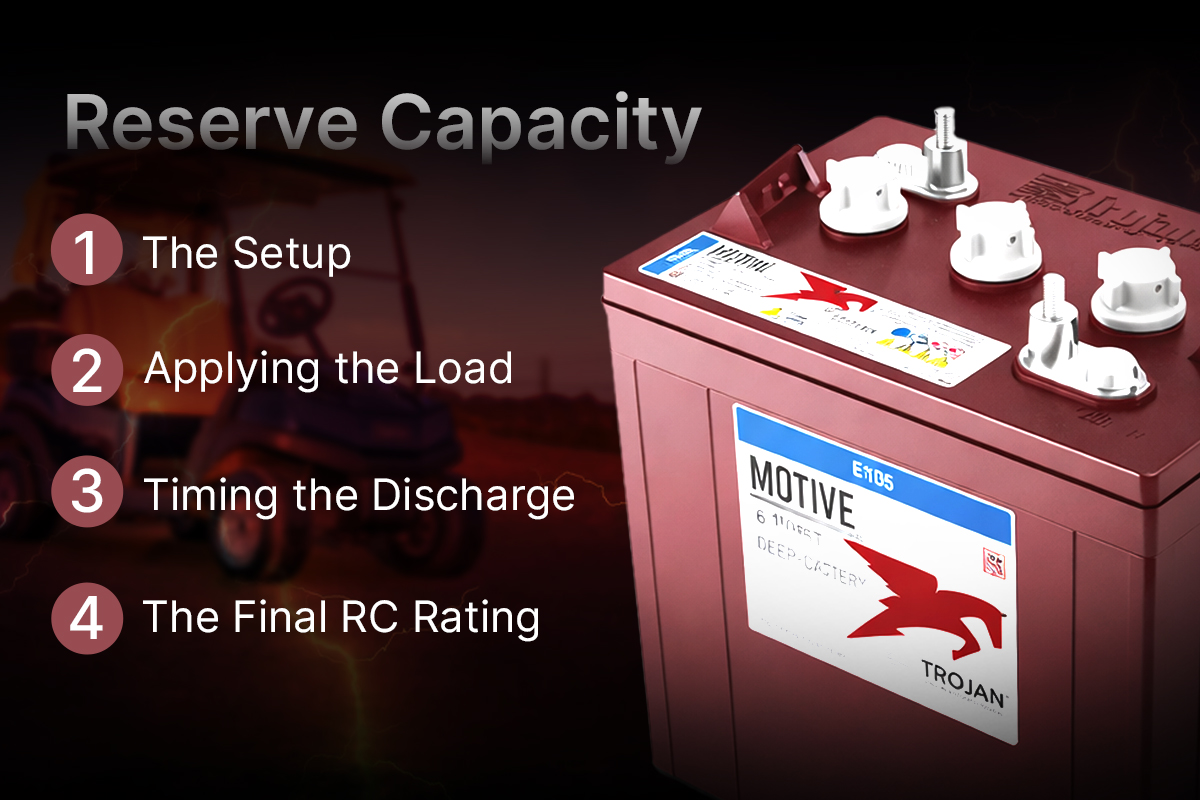
Here is how the test works, broken down into simple steps.
Step 1: The Setup
First, the test starts with a fully charged battery. The battery must also be at a normal temperature, around 80°F or 27°C. Temperature can change how a battery performs, so keeping it the same is important for a fair and consistent test.
Step 2: Applying the Load
Next, a constant load of 25 amps is put on the battery. Why 25 amps? This number was chosen because it is about how much power a car needs to run its basic systems. This includes things like the ignition, fuel pump, and headlights. It mimics a real-world scenario where your car’s charging system has failed.
Step 3: Timing the Discharge
Then, the clock starts. The test measures how many minutes the battery can provide this 25-amp current before its voltage drops to 10.5 volts. Once it hits 10.5 volts, the battery is considered fully discharged. At this point, it can no longer reliably power your vehicle.
Step 4: The Final RC Rating
The total number of minutes that passed is the battery’s RC rating. For example, if the battery lasted for 140 minutes, its RC rating is 140.
This precise measurement is not just a technical detail. It is what makes the reserve capacity rating so valuable. It gives you a clear and dependable idea of how long you can count on your battery in an emergency. This standard makes it easy to see which battery offers more stamina.
Why Reserve Capacity is Critical for Your Vehicle
Now you know what RC is and how it is measured. The next big question is, why should you care about it? Reserve Capacity is one of the most important factors for your vehicle’s safety and reliability.
The most important reason to check the RC rating is because of alternator failure. The alternator is the part of your car that recharges the battery while you drive. It also powers all the electrical parts when the engine is running.
If your alternator suddenly stops working, your battery has to take over the whole job. It has to power your engine’s computer, your fuel pump, your headlights, and everything else. Without the battery, your car would stop running immediately.
A battery with a high RC rating gives you more time. More time means you can drive to a safe spot, like the side of the road or a nearby mechanic. A battery with a low RC might only give you a few minutes, which might not be enough. This is why a good reserve capacity is like a safety net.
But RC is not just for emergencies. It is also important for situations where you are using power while the engine is off.
Have you ever sat in a parked car listening to the radio? Or maybe you were using your hazard lights while waiting for help. In these moments, your battery is the only thing providing power. A strong RC rating means you can do this without worrying about draining your battery so much that you cannot start the engine again.
The reserve capacity rating is especially important for vehicles with a lot of electronics. Modern cars have GPS, large screens, and many sensors. All these things use power. A good RC means your battery can handle the load.
While RC is a standalone number, its real value becomes even clearer when you look at it next to other battery ratings. This helps you get the full picture of what a battery can do.
RC vs. CCA vs. Ah: Understanding the Key Differences
When you look at a battery, you will often see three main ratings: RC, CCA, and Ah. They all measure different things. Understanding the difference is key to choosing the right battery for your needs.
It can be a little confusing, so we made a simple table to help you out.
Metric | What It Measures | Best For |
Reserve Capacity (RC) | Endurance: How long in minutes the battery can sustain a moderate load. | Emergency situations, or powering accessories when the engine is off. |
Cold Cranking Amps (CCA) | Starting Power: The battery's ability to start an engine in cold weather (0°F). | Regions with very cold winters. |
Amp Hours (Ah) | Total Capacity: The total amount of energy the battery can store over time. | Deep-cycle uses include RVs, boats, and solar power systems. |
Let’s break it down a bit more.
Reserve Capacity (RC): The Endurance Rating
Reserve Capacity (RC) is all about stamina, just like we discussed. It tells you how long your battery will last under a steady, moderate load. You can think of it as your safety cushion.
Cold Cranking Amps (CCA): The Starting Power
Cold Cranking Amps (CCA) is all about raw starting power. It measures how many amps a battery can deliver for 30 seconds at 0°F without the voltage dropping too low. If you live in a place where it gets very cold, a high CCA is extremely important because a cold engine is harder to start and needs that big jolt of power.
Amp Hours (Ah): The Total Capacity
Amp Hours (Ah) measure the total energy storage. It is usually calculated over a 20-hour period. For example, a 100 Ah battery can deliver 5 amps for 20 hours straight. This rating is very important for deep-cycle batteries, which are designed to provide a steady stream of power for a long time. This makes them perfect for things like trolling motors on a boat or running appliances in an RV.
It is also important to know that different types of batteries use different ratings. Most standard lead-acid batteries will show both CCA and RC. However, lithium batteries almost never use the RC rating. Instead, they are rated in Amp Hours because they discharge power differently and are better suited for measuring total capacity.
So, while RC, CCA, and Ah are all important, they tell different parts of the battery’s story. Because different jobs have different power needs, the perfect battery rating will change depending on what you are using it for.
What's a Good RC Rating for Different Batteries?
Now for the practical part. How do you know what RC rating to look for? The answer depends on your vehicle and how you use it. What works for a small car might not be enough for a large truck or a boat.
Here is a guide to help you choose the right RC rating for different types of vehicles.
For Standard Cars & SUVs
For most standard cars and SUVs, a typical battery will have an RC rating between 90 and 120 minutes. This is usually more than enough for daily driving. It provides a good safety margin for most situations, like a sudden alternator failure on your way home from work.
For Trucks & Vehicles with Accessories
If you drive a truck or a vehicle with extra accessories, you should look for a higher RC rating. Things like a winch, powerful off-road lights, or a big sound system put a lot more demand on the battery. For these vehicles, an RC rating of 140 or more is a smart choice. When you need that extra power for tough jobs, looking at a range of powersports batteries can help you find one that can keep up.
For Marine & RV Applications
When it comes to marine and RV use, Reserve Capacity is one of the most important ratings. These applications often involve running electronics for long periods when the main engine is off. This is known as deep-cycle use. For boats, you need to power fish finders, lights, and radios. In an RV, you run lights, a water pump, and maybe a small fridge. Investing in high-quality marine batteries with the highest possible RC rating is crucial for both safety and convenience.
For ATVs & UTVs
The story is similar for ATVs and UTVs. These smaller vehicles are often equipped with GPS units, extra lights, and phone chargers. A dead battery can leave you stranded far from anywhere. Having dependable ATV batteries with a solid RC rating means you have enough power for your ride and your gadgets.
As you can see, choosing the right battery is about matching its strengths to your needs. Ultimately, knowing what does RC mean on a battery helps you make a smarter choice. It allows you to pick a battery that will not let you down, no matter where your journey takes you.
Frequently Asked Questions
Have more questions? We have answers. Here are some of the most common questions people ask about Reserve Capacity to help you understand it even better.
Is a higher RC rating on a battery always better?
Yes, a higher RC rating is generally better. It means the battery has more stamina and can power your car’s essential electronics for a longer time in an emergency, giving you a bigger safety cushion.
What is a good RC for a car battery?
For most standard cars and SUVs, a Reserve Capacity rating between 90 and 120 minutes is considered good. This provides enough backup power for typical emergency situations, like an alternator failure during your daily commute.
Does RC matter more than CCA?
It depends on your needs. CCA (Cold Cranking Amps) is critical for starting your engine in cold weather. RC is critical for running electronics if your alternator fails. A good battery has a healthy balance of both.
How is Reserve Capacity different from Amp Hours (Ah)?
RC measures how many minutes a battery can sustain a specific 25-amp load. Amp Hours (Ah) measures the battery's total energy storage over a longer period, usually 20 hours. RC is for stamina, while Ah is for total capacity.
Do lithium batteries have an RC rating?
No, lithium batteries do not use an RC rating. Their chemistry is different, so their capacity is measured in Amp Hours (Ah). The RC test is specifically designed for the discharge characteristics of lead-acid batteries.
Why RC is More Than Just a Number
We have covered what Reserve Capacity is, how it is tested, and why it is so important for your vehicle. The main thing to remember is that RC is your battery’s safety net. It is the endurance that takes over if your car’s charging system fails, giving you precious time to get somewhere safe instead of being stranded on the side of a dark road.
So, at the end of the day, what does RC mean on a battery? It means security. It is your built-in backup plan that keeps your essential systems running and gives you peace of mind. Next time you are buying a battery, do not just look at the starting power. Look for the RC rating, because that is the number that will keep you going.