
PowerPulse: What Is It And Do They Work? PulseTalk October 2026
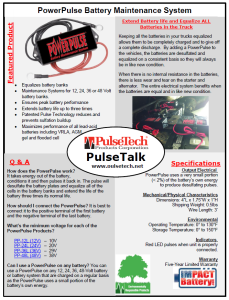 In this month’s edition of PulseTalk, we will be exploring the PowerPulse onboard desulfators and how they should be used within a Battery Maintenance System (BMS). These tiny, yet powerful, devices help ensure peak battery performance and can extend battery life up to three times using patented pulse technology.
PowerPulse is a battery maintenance technology designed to help reduce sulfation in lead-acid batteries. It sends high-frequency electronic pulses through the battery, which can help break down sulfate crystals and improve battery performance and lifespan.
Sulfation is one of the most common causes of battery failure. When a battery remains partially discharged for extended periods, sulfate crystals can build up on the battery plates, reducing its ability to hold a charge. PowerPulse technology aims to minimize this buildup and keep the battery operating more efficiently.
Many vehicle owners, RV users, and equipment operators use PowerPulse devices to maintain batteries during storage or regular use. While it cannot repair severely damaged batteries, it may help extend battery life, improve charging efficiency, and support more reliable starting performance when used as part of a proper battery maintenance routine.
So, How Does the PowerPulse Work?
PowerPulse works by sending high-frequency electronic pulses through a lead-acid battery. These pulses help reduce sulfate crystal buildup on the battery plates, improving charge acceptance, maintaining performance, and potentially extending battery life by minimizing one of the primary causes of battery degradation.
The PowerPulse uses a patented pulse technology that reduces and prevents sulfation buildup on lead acid based batteries. The ongoing process allows the batteries to be completely charged and to give off a complete discharge. This constant equalization effect reduces internal resistance in the batteries, leaving them in like new condition.
You will save many man-hours needlessly replacing ‘spent’ batteries and will obviously not have to spend your hard earned cash buying new batteries as often. For batteries used in starting vehicles there is an added benefit; lower internal resistance means there will be less wear and tear on your starter and alternator.
How Do You Deploy the Power Pulse?
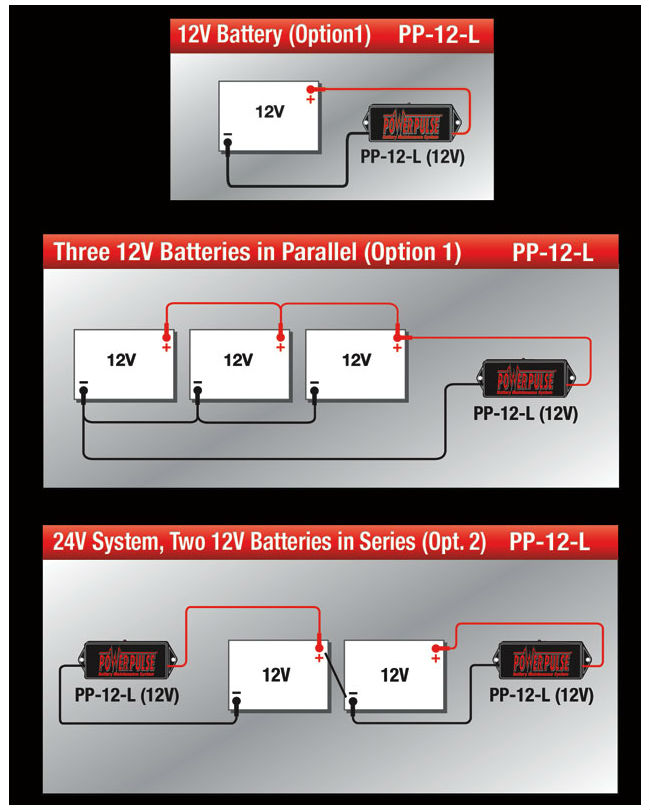 The PowerPulse onboard desulfators come in four standard voltages: 12V, 24V, 36V and 48V. They can be used with any lead acid based battery system including VRLA, Gel, Flooded and AGM batteries. You would then create an individual or series connection matching the above voltages. Ideally, you would want to deploy the PowerPulse on a battery system that is charged regularly as they utilize less than 2% of the battery’s own energy to operate. Over time, if the system is not regularly charged, the batteries will become discharged. This energy usage would be akin to a parasitic drain.
We like to use these onboard desulfators more in a preventative scenario vs. a restorative rejuvenating scenario. How does the saying go? An ounce of prevention is worth a pound of cure. It seems far easier and less costly to prevent sulfation before it starts. Can they be used in both situations, most definitely yes, but we feel Pulse Tech has created better tools, mainly desulfating chargers, to more efficiently deal with the debilitating effects of sulfation. It could take the PowerPulse 2-10 weeks to reverse the effects of a heavily sulfated deep cycle battery while a desulfating charger could complete the task in 24-72 hours. In short, proper charging algorithms coupled with patented pulse technology are essential and time is money.
For more on this topic including reviews of other Battery Maintenance System components please see our PulseTalk category or jump over to our Sulfation FAQ Review page.
Frequently Ask Questions (FAQs)
PowerPulse devices help maintain lead-acid batteries by sending high-frequency pulses that may reduce sulfation. They work best as preventive tools, not solutions for completely dead batteries. Most models support flooded, AGM, and gel batteries, operate automatically, and may improve charging efficiency and extend battery life over time.
What Is a PowerPulse Device?
A PowerPulse device is an electronic battery-maintenance accessory designed primarily for lead-acid batteries. It connects directly to the battery terminals and sends controlled electrical pulses through the battery while it is in use or storage.
These pulses are intended to help reduce the formation of lead sulfate crystals on the battery plates. Excessive sulfate buildup, commonly known as battery sulfation, can reduce charging efficiency, lower available capacity, and shorten a battery’s service life.
A PowerPulse device should be viewed as a maintenance tool rather than a charger. It does not replace regular charging, battery testing, terminal cleaning, or other essential maintenance procedures.
Does a PowerPulse Device Really Work?
A PowerPulse device may help slow down sulfate accumulation and support more efficient battery performance. Its effectiveness depends heavily on the condition, age, usage pattern, and maintenance history of the battery.
A relatively healthy battery with mild sulfation is more likely to benefit than an old battery with damaged plates, internal corrosion, or a failed cell. Results may also vary based on operating temperature, charging habits, discharge depth, and the quality of the electrical system.
PowerPulse technology should not be treated as a guaranteed repair solution. It may support battery health, but it cannot correct every cause of poor battery performance.
Can a PowerPulse Device Restore a Dead Battery?
A PowerPulse device is generally not capable of restoring a completely dead or severely damaged battery. Batteries with shorted cells, cracked plates, electrolyte loss, internal corrosion, or extensive physical damage usually require replacement.
The device may have some benefit when a battery is still functional but has experienced mild or moderate sulfation. In these situations, continuous pulsing may gradually help improve charge acceptance and available capacity.
Before attempting to recover a weak battery, test its resting voltage and perform a proper load or capacity test. A battery that cannot hold a charge after correct charging is unlikely to be repaired by a maintenance device.
Which Batteries Are Compatible With PowerPulse?
PowerPulse devices are commonly designed for lead-acid battery systems. Depending on the specific model, they may be compatible with flooded lead-acid, AGM, gel-cell, deep-cycle, marine, RV, automotive, motorcycle, and industrial batteries.
Compatibility is not determined only by battery type. The device must also match the voltage of the battery system, such as 6-volt, 12-volt, 24-volt, 36-volt, or 48-volt configurations.
Do not connect a PowerPulse device to a lithium-ion battery unless the manufacturer specifically confirms lithium compatibility. Using an incompatible device may damage the battery or its battery management system.
How Long Does It Take for PowerPulse to Show Results?
PowerPulse devices are designed to work gradually rather than produce immediate changes. Depending on the battery’s condition and level of sulfation, noticeable improvement may take several weeks or even a few months of continuous operation.
A battery with light sulfate buildup may respond faster than one that has been neglected or repeatedly left in a discharged state. Battery usage, charging frequency, temperature, and discharge depth can also affect the recovery process.
Battery voltage, charging time, starting performance, and capacity should be monitored over time. If performance continues to decline, the battery should be professionally tested instead of relying entirely on the pulse device.
Does a PowerPulse Device Require External Power?
Most PowerPulse devices do not require a separate external power source. They draw a very small amount of energy directly from the connected battery and operate automatically after proper installation.
Because the current draw is usually low, the device should not significantly discharge a regularly used or properly maintained battery. However, any electrical accessory can contribute to battery drain if the battery is stored for a long period without charging.
For vehicles, boats, or equipment kept in seasonal storage, combining the device with an appropriate battery maintainer may provide better protection. Always follow the manufacturer’s instructions regarding installation and long-term storage.
Can PowerPulse Extend Battery Life?
A PowerPulse device may help extend the useful life of a lead-acid battery by reducing sulfation and supporting better charge acceptance. Keeping the battery plates cleaner may help the battery charge more efficiently and maintain usable capacity for longer.
However, the device cannot protect a battery from every type of damage. Overcharging, deep discharging, extreme temperatures, poor connections, electrolyte loss, and faulty charging systems can still shorten battery life.
The best results come from combining PowerPulse technology with correct charging, regular voltage testing, clean terminals, proper storage, and timely electrolyte checks for serviceable flooded batteries. It should be considered one part of a complete battery-maintenance routine, not a substitute for proper care.
Conclusion
PowerPulse is a battery maintenance technology designed to combat sulfation, one of the leading causes of lead-acid battery failure. By sending electronic pulses through the battery, it helps maintain performance and improve charge efficiency. While it cannot repair severely damaged batteries, it can be a useful tool for preventive maintenance. When used alongside proper charging and regular battery care, PowerPulse may help extend battery lifespan and improve overall reliability.


