Can I Afford and Do I Need Lithium Batteries in My Bass Boat?

Have you noticed that lithium battery sponsors are lining up some big names in the bass fishing world?
Bassmaster Elite Series Pro, Patrick Walters, touts Relion. Bill Weidler pitches Impulse lithium batteries. Clark Wendlandt, the Bassmaster 2020 Angler of the Year, is sponsored by Lithium Pro. Same goes for Ott Defoe.
These are some big names in the fishing world singing the praises of lithium. Albeit these accolades probably have some Benjamin’s written on them.
On the surface, and despite the obvious sponsorships, the push towards this new power source seems to make sense. There are several observed advantages to lithium technologies.
But at the end of the day you, as an avid angler, must ask yourself, do I really need lithium marine batteries in my boat? Will these lithium marine batteries truly offer a better experience on the water?
Ultimately, it really comes down to memories and money. For most of us, money still matters. To that end, can doubling or tripling the upfront out-of-pocket expense be justified? Do the ported benefits outweigh the cost and will lithium allow me to make better family memories?
The Benefits: Lithium, Prove You're Worthy
Faster Charge Times
Faster charge times may appeal to those who fish 24/7 or have installed batteries that are functionally too small for their boat. For the rest of us, an overnight charge will suffice. We won’t notice that it finished charging at 11PM vs 4AM.
Selecting the correct smart charger is a must. Lithium batteries can handle and like to be charged faster than lead-acid batteries. You can charge up to 100% of its stated capacity.
Weight Savings
I think everyone knows by now that lithium batteries are near half the weight of lead batteries. For most boats that weight savings will have a noticeable performance difference as you can now better distribute your overall weight.
Less Maintenance
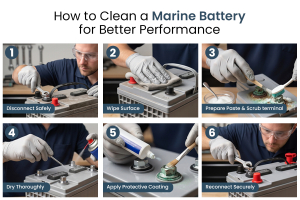
Lithium batteries require less maintenance. There is no need to add electrolyte or distilled water. There is no clean-up of boiled over acid or corroded terminals. They don’t discharge as fast and prefer to be left off the charger when in storage.
Lasts Longer
Really?
Yes.
Well, in theory…
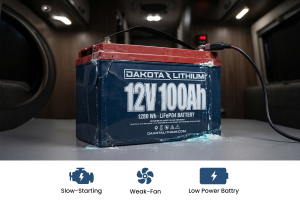
The quote below the Kayak, published by Clean Republic, the company behind the Dakota Lithium battery brand conveys confidence. It is marketing genius. Who wouldn’t want to learn more about a product that lasts 200% longer!
Let me try and help make sense of what’s behind this claim. Because if you think about it kind of sounds like they are saying 1+1=3.
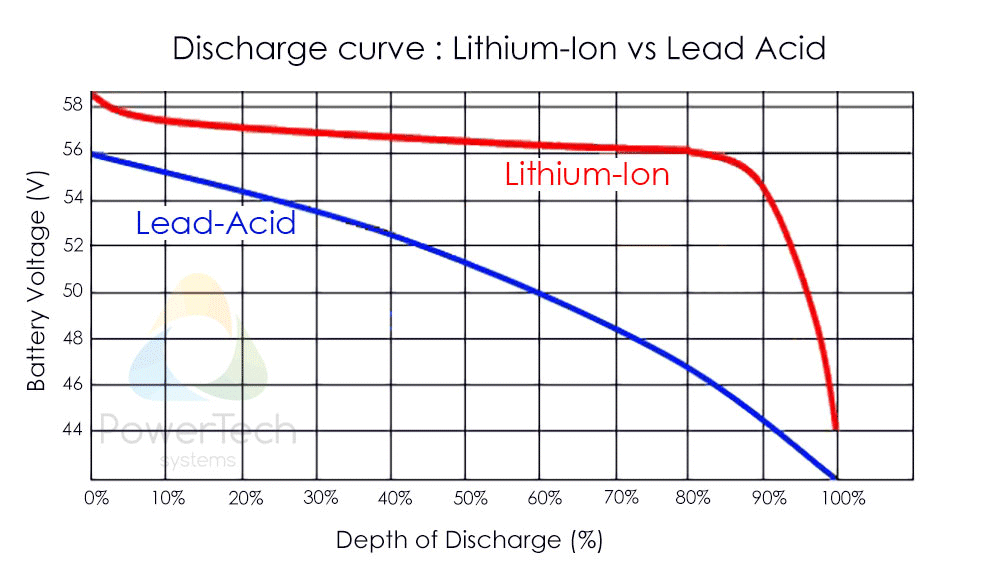
To gain understanding we first need to discuss energy density. The energy density of a lithium battery is higher than the energy density of a traditional lead acid-based battery (flooded, sealed AGM and Gel).
The higher density allows for the voltage discharge curve of lithium batteries to be relatively flat when contrasted to their lead-acid counterparts (See image below).

The Downside: Every Good Thing Comes to an End
Quality Concerns
Ten years ago, we bought the hype. Today we’re gun shy.
The failure rates for lithium batteries across applications including marine, motorcycle and solar have been substandard. In some cases, failure rates were in the 20% range!
The overall failure rates have come down but can still be in the upper single digits. We still feel there is an inconsistency in manufacturing standards. A brand can be great for a period and then suspect or awful shortly thereafter.
What is most frustrating is when you have two or three lithium batteries, and one consistently seems to lag despite being in the same application. It is not that it isn't working, but it is not working as well as the others. Change that scenario up a little and imagine it were the only battery purchased, you may never even realize the short coming. But you certainly did not get what you paid for either!
New Charger Required
You CANNOT use the same lead acid-based charger to charge your lithium marine batteries. You will need to purchase a new charger. A quality marine charger with a high IP65 or higher rating could cost an additional $200 million. Nah not really. I was just seeing if you were still paying attention.
The prices on chargers are all over the place. Quality, the number of DC banks, where it’s made, water proofing and larger amperage output drive up the cost. Expect to pay $50 to $500 on a new charger.
Financial Burden
Here is the crux of it all. Money.
Consider the cost of an average group 31 lithium marine battery. Prices range from around $800 to $1300 per battery. Reputation, quality, and extra technology such as Bluetooth connectivity or built in BMS (Battery Management System) create that wide range in price.
A basic to high performing AGM battery will range in price from around $275 to $475.
The high performance MotoBatt AGM that Dustin installed (130Ah) run around $400 including freight. The Dakota Lithium 100Ah group 31 we quoted earlier, run around $900 each.
For the record, both battery types will be near 2-8x more costly than a flooded lead acid type.
Multiply these numbers by 2, 3 or 4 depending on if you run a 24V or 36V trolling motor with separate starting and or auxiliary battery. We are not talking chump change!
Two lithium batteries could be as low as $1600 vs $600 for AGM. Four lithium marine batteries could cost no less than $3200 and as high as $5000 compared to $1200 for 4 quality AGM’s.
Lithium Marine Batteries vs Lead Acid AGM Conclusion
Are lithium marine batteries worth the price of admission? With what we just highlighted, does lithium seem like the best choice for the average fisherman?
First, before we can answer, there is one more aspect we should consider. Lifespan.
A properly sized, well maintained AGM battery will typically last 5-7 years. But let’s face it, we’re all human and will forget to charge the battery for a short timespan or will buy the cheapest or improperly sized charger that will help shorten the useful lifespan. But even in these cases 3-5 years is typical.
Both of those scenarios are a far cry to what Ott Defoe – Lithium Pros brand ambassador--says 30 seconds into his promo video where he states AGM batteries will only last 12-18 months! This needs to be stated clearly: You are buying the wrong batteries and/or doing something wrong if this is you.
If you can get past the consistent quality concerns we have witnessed (from every brand), lithium batteries are expected to last 10 years or more. In some cases, we feel it is theoretically possible to reach 20 years of useful life. NOTE: clients of ours report their AGM lead acid batteries have lasted 17 years.
Lithium vs AGM Verdict:
At this point in time, we DO NOT feel the increased cost coupled with the nagging reliability issues outweighs the stated benefits. It is not an easy call to make and may dampen our lithium manufacturer relationships. But for the everyday angler just looking to get away and relax, it’s the right call to make.
For right now, money could be better spent on other gear and focusing on family memories that last for generations. That is money well spent!
As we look to the future, we can only hope companies like MotoBatt will continue to innovate. If they expand their incredibly powerful and reliable Lithium/AGM Hybrid Battery technology beyond powersport applications and into their deep cycle line…wow! That would be something to get behind!