RV Battery Health Monitoring System: Stop Guessing, Start Knowing
Your RV battery can fail without any warning at all. One moment everything runs fine. The next, your lights go dark and your fridge stops cold.
That's why a reliable RV battery health monitoring system matters so much. RV owners all across the USA lose time and money from poor battery tracking. Knowing your battery's true state keeps every trip smooth and stress-free.
In this guide, you will learn both ways to monitor your RV battery. First, we cover manual checks you can do with simple tools. Second, we walk through smart battery monitoring devices that track everything for you in real time.
Why RV Battery Monitoring Matters More Than You Think
Your battery runs every key system inside your RV. Lights, fans, refrigerators, and water pumps all pull from it. Lose that power mid-trip and the whole experience falls apart fast.
Most RV owners check the battery only after something goes wrong. By then, the damage is already done and the costs are rising. Routine monitoring keeps you one step ahead of every problem.
A well-tracked battery also lives much longer overall. Deep discharge and overcharging are the two fastest ways to ruin a battery. Watching your levels daily helps you stay within safe limits at all times.
What Happens When You Skip Battery Monitoring?
Skipping battery checks is like driving without a fuel gauge. You have no real idea how much power is left. That leads to dead batteries at the worst possible times.
Neglecting your battery health also costs you more money in the long run. Batteries that fail early are expensive to replace. A quick daily check can save you hundreds of dollars down the road.
Two Ways to Monitor Your RV Battery
There are two solid ways to track your battery health on the road. You can use basic tools you may already own for a manual check. Or you can install a digital battery monitoring system for real-time, accurate data every single day.
Both approaches have real value in the right situation. Most new RV owners start out with manual voltage checks. Over time, many upgrade to a dedicated RV battery monitor for daily use on longer trips.
Manual Monitoring: The Old-School Method
Manual monitoring is low-cost and easy to start right away. All you need is a digital multimeter and a hydrometer for flooded battery types. These two tools give you a solid look at your battery's current health.
Here is how to run a basic battery voltage check. Set your multimeter to DC volts. Then touch the red probe to the positive terminal and black to the negative.
A fully charged 12V battery at rest should read 12.6V or higher. A reading below 12.0V means the battery needs a charge right away. Always test after the battery has rested for at least two hours with no load.
For flooded lead-acid batteries, a hydrometer adds real depth to your checks. It tests the specific gravity of the electrolyte fluid in each cell. This gives you a cell-by-cell view of the true state of charge inside.
Visual inspection rounds out your manual monitoring routine. Look for corroded terminals, a swollen battery case, or any visible cracks. These quick checks take under five minutes but can save an entire camping trip.
Digital Battery Monitoring Devices: The Smart Way
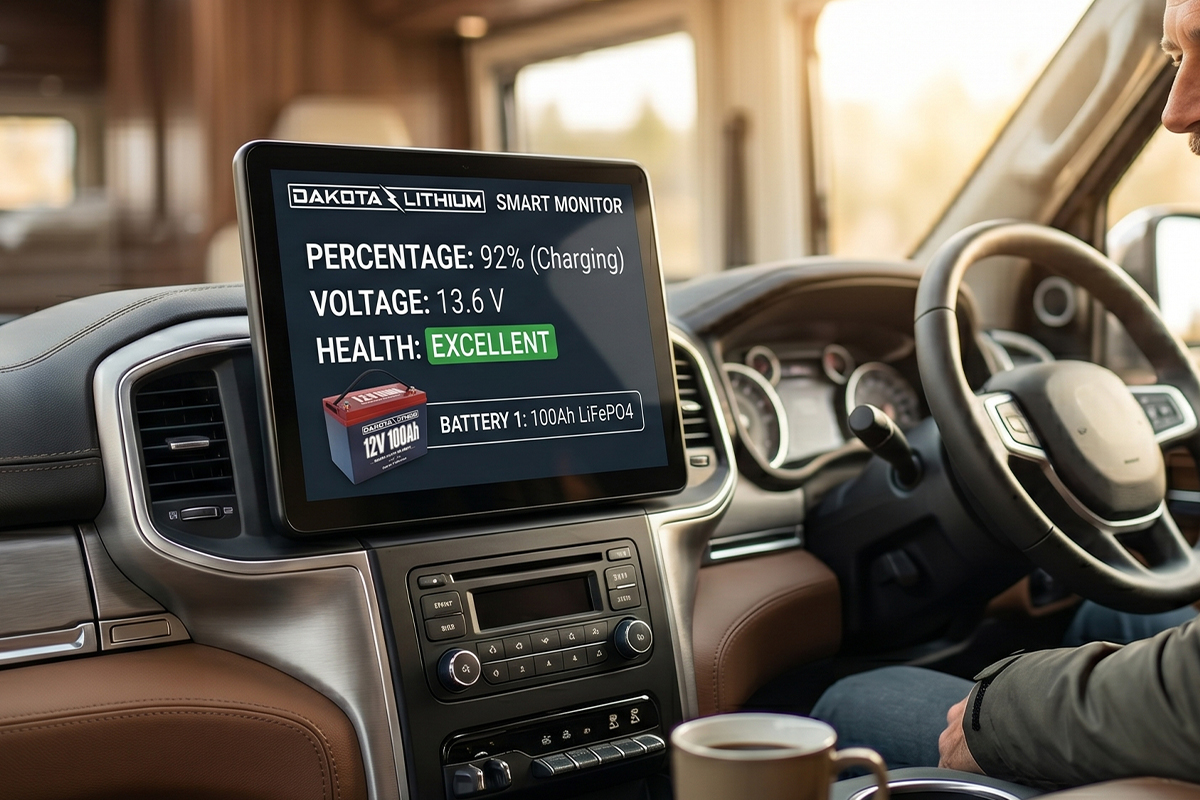
A digital battery monitoring system removes all the guesswork from your power setup. It tracks voltage, current, and amp-hours in real time, every single day. You always know exactly what is happening inside your battery bank.
Most units mount inside the RV for easy reading at any moment. Some connect wirelessly to your smartphone through Bluetooth. This lets you track your battery without ever leaving your chair.
These devices work especially well with lithium iron phosphate (LiFePO4) batteries. Lithium chemistry holds a nearly flat voltage curve during most of its discharge cycle. That makes it very hard to read true charge levels from voltage alone.
A shunt-based smart battery monitor solves that problem completely. It uses a method called Coulomb counting to track every amp-hour in and out. This delivers a far more precise battery state of charge reading at any point in time.
What to Look For: Key Battery Health Metrics
Good monitoring means watching the right numbers every single day. Not every data point tells the same story about your battery's condition. Some readings matter far more than others for making smart daily decisions.
Voltage and State of Charge (SOC)
Voltage is the most basic reading on any RV battery voltage monitor. It tells you roughly how full your battery is right now. But it only gives accurate data when the battery has rested for a few hours.
State of charge (SOC) is the more useful daily number to track. It shows the exact percentage of energy left inside your battery bank. Think of it like the fuel gauge in your car.
You would not drive 500 miles without checking the gas gauge first. The same habit keeps your RV battery from leaving you stranded on the road. Always know your SOC before heading out for any trip.
Amp-Hours and Depth of Discharge
Amp-hours (Ah) measure the total energy your battery can store and deliver. A 100Ah battery can give you 100 amps for a full hour. Tracking how much of that you use each day tells you when to stop drawing power.
Depth of discharge (DoD) is how far down you drain your battery each cycle. For lead-acid batteries, try to stay above 50% charge at all times. Lithium batteries handle much deeper discharge without causing lasting cell damage.
Staying within safe DoD limits protects your battery over the long run. It also adds hundreds more complete cycles to its total lifespan. A good battery health monitor does this tracking math for you automatically.
RV Battery Voltage Chart: Know Where You Stand
Use this table to guide your 12V deep cycle battery checks at home or on the road. Let the battery rest for two to four hours before taking a reading. No charging and no active loads should be running during the test.
State of Charge | Flooded Lead-Acid | AGM | LiFePO4 (Lithium) |
100% | 12.65V | 12.80V | 13.60V |
75% | 12.45V | 12.60V | 13.30V |
50% | 12.20V | 12.35V | 13.10V |
25% | 12.00V | 12.10V | 12.80V |
0% (Discharged) | 11.80V | 11.90V | 12.00V |
If resting voltage on a lead-acid battery falls below 12.0V, recharge it right away. Sitting at low voltage for too long causes sulfation, which permanently cuts battery capacity. Lithium batteries are more forgiving, but they still need regular top-ups to stay healthy.
Note that cold temperatures can drop voltage readings by up to 0.2V without real capacity loss. Always factor in temperature when reading your multimeter or your battery monitor display. A warm battery will always give the most accurate resting voltage result.
Now let's look at the monitoring devices that track these numbers automatically for you.
Types of RV Battery Monitors
Not all battery monitors are built the same way. Some are simple and budget-friendly. Others give you a full, real-time picture of your entire battery bank in one display.
Simple Voltage Monitors
A simple RV battery voltage monitor shows your current battery voltage on a small screen. It costs very little and installs in just a few minutes. These are a solid starting point for newer RV owners watching a tight budget.
But voltage alone is not always an accurate reading to rely on. A battery receiving solar input reads higher than its actual state of charge. That inflated number does not mean the battery is truly full.
Simple monitors also struggle with LiFePO4 lithium battery setups. LiFePO4 voltage stays nearly flat between 20% and 90% of its charge. This makes voltage a poor indicator of actual capacity for lithium systems.
Shunt-Based Battery Monitors
A shunt-based battery monitor is the most accurate type you can install. It mounts directly on the main negative cable of your battery bank. It then measures every single amp flowing in and out of the system.
This method is called Coulomb counting and it is extremely precise. It logs each amp-hour added during charging and every one removed during use. Then it calculates exactly how much energy remains in your bank right now.
Shunt monitors display SOC percentage, voltage, amps, watts, and time remaining. They work with flooded, AGM, and lithium batteries across every setup type. Most RV experts call this the gold standard of battery health monitoring for a reason.
Bluetooth Battery Monitor
A Bluetooth battery monitor adds wireless convenience to your entire power system. You skip the need for a wired display panel mounted inside the RV. Your smartphone becomes your live battery dashboard instead.
These units connect to a free app on your phone or tablet. You see real-time battery data from anywhere inside or near your RV. Many models also push low-voltage alerts straight to your phone automatically.
Bluetooth monitors are a great match for solar and off-grid setups especially. You can check your battery state of charge while relaxing by the campfire. That level of instant visibility completely changes how you manage power day to day.
Warning Signs Your RV Battery Is in Trouble
Your battery always gives clear warning signs well before it fully fails. Learning to spot them early saves you money and avoids major travel stress. Both physical signs and performance changes are worth checking on a regular basis.
Physical Warning Signs
Start by looking at the battery case itself before anything else. A swollen or bulging battery is a serious red flag you cannot ignore. It points to internal damage or heat buildup that needs immediate attention.
Check the terminals for any sign of corrosion. White or green powder around the posts restricts electrical flow to your system. Clean it off with baking soda and water to restore a solid connection.
Look for cracks in the case or any fluid leaking from the sides. A leaking battery is a real safety hazard on the road. Replace it right away the moment you find any damage at all.
Performance Warning Signs
Does your battery drain faster than it did a few months ago? That is a clear sign of reduced battery capacity inside the cells. Track your daily amp-hour use with a battery monitor to spot this trend early.
Is your battery taking longer than usual to reach a full charge? Slow charging often means sulfation is forming inside the battery. Sulfation is a buildup of lead crystals that blocks energy flow and storage.
Do your appliances shut off much sooner than you expect? Use an RV battery tester or load tester to verify the output. A healthy battery should hold at least 9.6V under a full 15-second load test.
If your battery fails a load test, it is time to act before it fails you on the road.
Choosing the Right RV Battery for Long-Term Health
The battery you pick affects how easy it is to monitor over time. Different chemistries behave very differently under load and during charging cycles. Choosing the right type makes your whole RV battery health monitoring system more effective from day one.
Here is a quick look at the best options for every type of RV setup:
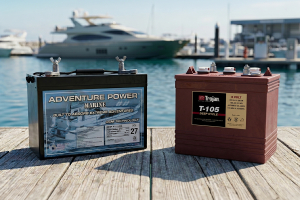
Trojan T-105 | 6V, 225Ah | Flooded Lead-Acid The trusted Trojan T-105 is a proven 6V battery built for large, budget-friendly banks. It handles repeated deep discharges well. Just remember to top off the water regularly and keep it properly ventilated.
Trojan T-875 | 8V, 170Ah | Flooded Lead-Acid The rugged Trojan T-875 delivers 8V and 170Ah in a compact GC8 form factor. Pair it with a shunt-based monitor for precise tracking results. It is a top pick for full-time motorhome users with high daily energy demands.
Dakota Lithium | 12V, 100Ah | LiFePO4 Lithium fans love the lightweight Dakota Lithium 12V 100Ah for its 100% usable capacity and fast recharge. It includes a built-in BMS for overcharge and over-discharge protection. This is the go-to pick for solar and off-grid setups.
Lifeline GPL-27T | 12V, 100Ah | AGM The USA-made Lifeline GPL-27T is sealed, maintenance-free, and built to military-grade specs. It pairs well with a 12V battery monitor for clean, reliable daily data. A great pick for RVers who want zero upkeep and long cycle life.
Lifeline GPL-4CT | 6V, 220Ah | AGM For series-wired bank builds, the reliable Lifeline GPL-4CT is a top sealed AGM choice. It handles heavy duty cycles well and holds up great in large off-grid setups. Add a smart battery monitor for full power visibility at all times.
Not sure which battery fits your rig? Browse the complete RV batteries collection to match your voltage, capacity, and chemistry needs. Their team also helps you pair the right battery with the right monitoring gear.
How Often Should You Check Your RV Battery?
How often should you check your RV battery? The answer is simple: before every single trip. A quick battery voltage check takes under two minutes and can prevent hours of trouble on the road.
During active camping, check your state of charge every morning. This tells you how much power you actually used through the night. It also shows you if your solar panels or charger kept up with demand.
Every one to three months, run a deeper inspection of your battery. Check for terminal corrosion, test electrolyte levels in flooded batteries, and inspect the case closely. A seasonal inspection keeps your battery capacity performing at its best through the year.
Once a year, run a full battery capacity tester cycle to check real-world output. Fully charge the battery, then discharge it under a known load. Compare the runtime to what you got when the battery was brand new.
Common Mistakes RV Owners Make With Battery Monitoring
Avoiding these errors can add years to your battery's life. Here are four common monitoring mistakes to watch out for:
Trusting your inverter or solar controller display: Those screens track input energy, not your battery's true state. They give you a skewed reading that feels accurate but is not. Always use a dedicated battery health monitor for data you can trust.
Testing the battery while it is under load: Running your fridge or appliances drags voltage down artificially. This creates a false low reading that hides your battery's actual charge level. Always let the battery rest before taking any voltage reading.
Mixing different battery chemistry types in the same bank: AGM, flooded, and lithium all charge at different voltage rates. Mixing them causes uneven charging inside the bank. This shortens the life of every single battery in the setup.
Skipping calibration after a battery replacement: Old data in your monitor throws off your SOC readings for days. A fresh calibration sync fixes this right away. It keeps your RV battery monitor accurate from the very first charge cycle.
Frequently Asked Questions
Got questions about RV battery monitoring? You are not alone. Here are the most common questions RV owners ask, answered simply and clearly.
What voltage should my fully charged RV battery be?
A fully charged 12V lead-acid or AGM battery reads 12.6V to 12.8V at rest. A lithium (LiFePO4) battery reads around 13.6V when full. Always test with no active load or charger running for an accurate reading.
How does a shunt-based RV battery monitor work?
A shunt sits on the main negative cable of your battery bank. It tracks every amp going in and out using a method called Coulomb counting. This gives a far more accurate state of charge reading than voltage alone.
Can I monitor a lithium battery with a simple voltage monitor?
Not really. Lithium (LiFePO4) voltage stays nearly flat between 20% and 90% charge. This makes voltage alone a poor way to read the true state of charge. A shunt-based or Bluetooth battery monitor gives far better accuracy.
How often should I check my RV battery?
Check your battery before every trip with a quick voltage test. During camping, check the state of charge each morning. A deeper inspection every one to three months keeps everything in top shape.
What is the difference between state of charge and battery voltage?
Voltage is a raw electrical reading from the battery terminals. State of charge (SOC) shows the exact percentage of energy left inside. SOC is more useful for daily decisions. Voltage is only accurate when the battery is fully at rest.
Do I need a battery monitor for every RV battery type?
Yes, every RV battery benefits from monitoring. Lead-acid types work fine with basic voltage checks. Lithium batteries need a shunt or Bluetooth battery monitor for accurate data. Monitoring extends battery life and prevents costly failures on the road.
Don't Let a Dead Battery End Your Trip. Take Control Today.
A proper RV battery health monitoring system turns guesswork into real, actionable data. Real data means better trip decisions, a longer battery lifespan, and fewer costly surprises. Both manual checks and smart monitors work together to keep you fully powered.
Whether you use a multimeter or a Bluetooth battery monitor, consistency matters most. Check your battery often, know your numbers, and stay ahead of costly problems. Acting early is always cheaper than dealing with a dead battery on the road.
For RV owners all across the USA, Impact Battery has exactly what you need. They stock deep cycle, AGM, and lithium batteries for every rig and budget. Pick the right battery, monitor it well, and enjoy every single mile ahead.