Solar Tutorial
Solar Tutorial
back to tutorials
back to Impact Battery homepage
Solar Energy – How it Works
Sections:
How Solar Panels Work - Where & How to Place Panels - How to Calculate Panel size - The Solar Controller
The Solar Battery Bank - The Power Inverter - Differences Between Types of Solar Panels
A Brief Solar Introduction
We will attempt to explain the principles behind solar energy (solar power, photovoltaic’s) in simple terms without putting you to sleep. I think we can all understand that the sun heats things up. One of the earliest uses of this solar energy was the creation of a solar shower—A large enclosed (often black painted) metal bucket filled with water set upon a roof top. The sun would heat the water and provide hot to warm showers, at least for the first person cleaning up for the day!
The sun heats things up because sunlight is made up of small particles of energy called photons (a basic “unit” of light and all other forms of electromagnetic radiation). These photons are absorbed by objects and create heat. The heat is the result of electrons in the object moving around really fast. Think of a bridge in winter and summer. During the winter the small gaps in the road surface are larger than in the summer. The electrons are “cold” in the winter when there is not as much sunlight and stick closer together or contract. In the summer they are “hot” and expand to get away from each other.
Solar Energy Applied to a Solar Panel [top]
Solar panels are made from a material called silicon. When the solar energy (the photon) is absorbed they dislodge electrons from the negatively charged side of the solar (photovoltaic) panel to the positively charged side. An entire tutorial could be written outlining the makeup of silicon “doped” with phosphorous and boron which creates the +/- charged silicon, but for simplicity understand that heated-up electrons “run around” in search of a “place to rest.” As these electrons move freely about the electric field (created by photons hitting the negatively charged silicon that is in contact with the positively charged silicon), they create current. In between the positive and negative sides is the electric field or diode that permits one way traffic flow from negative to positive. The electric field creates the voltage. Harnessing this voltage by providing a path for this current to flow freely from the positive side back to the negative side is how we get power.
Solar Energy – Creating Your System
Choose Wisely
Solar power is a wonderful use of “free” energy. But if you use it incorrectly you could damage sensitive electronics such as laptop computers. It is prudent that you select the right materials and location to satisfy the requirements for your solar powered system.
Your Basic Solar Needs [top]
The obvious place to start is with the sun! When creating a solar system think about how much sunlight will come in contact with the solar cells. If you are creating a permanent location consider where shadows fall, as this will reduce or eliminate the current provided by the solar panel. Also, consider geographic and weather related obstacles such as your latitude, fog, the number of cloudy days, and winter snows. If your system is portable you need only find the sunniest location to deploy your solar panel. To create optimal performance you need to consider the tilt and angle orientation of the solar panels. Solar panels should always face true south in the Northern Hemisphere, and North in the Southern Hemisphere. A good rule of thumb is to tilt your panel, from horizontal, your latitude plus 15o in winter and minus 15o in the summer. There are many online resources that can help in determining the best positioning of your solar photovoltaic panels and we encourage you to look at them.
Selecting the appropriate size solar panel is the next consideration. There are many variables to consider, including the amount of sunlight hours, power requirement of your system, and the total hours the system will be in use per day. The power wheel to the right is not meant to scare you or have your eyes gloss over. It simply illustrates the relationship between power (watts), voltage (volts), current (amps), and resistance (ohms).
How to Calculate and Convert [top]

To calculate this information we suggest you use a solar calculator. The basic idea is to convert your AC current usage to DC current usage and then into watts.
- First, you need to convert AC amps to DC amps. Remember this ratio for converting AC 120V amp units to DC 12V amp units: 1 amp = 10 amps (for example if your laptop adapter indicates it uses 1.7 input AC amps per hour that is equal to 17 DC input amps every hour).
- Second, you need to multiply that number by 12 volts to determine the total watts per hour (in our example 17Ah x 12V = 204 watts).
- The third step is to resolve how many hours the application will be in use. Multiply the total watts/hr by the total number of hours the device will be in use per day (for our example let’s use 2 hrs x 204W = 408 watts per day).
- The fourth aspect to consider is the amount of sun hours available to recharge your batteries. Do you need to have your system keep up with 24/7 use or is there a period of down time between uses? The average sun hours available during a day are 5 depending on season and latitude.
At 12 volts this tells us for our example to “break even” under perfect solar conditions we need a solar array that can create a minimum of 408W or 34 DC amps per day. Not accounting for imperfect light conditions, resistance and any conversion loss this example would require a solar panel around 110 watts minimum. For applications running for longer periods of time (permanent) you will also have to calculate for solar loss, conversion loss, and the size of battery bank needed to bridge the gap.
NOTE: Most laptops come with DC adapters which are much more efficient at converting to your laptops DC voltage than from the AC adapter. In this same example the DC adapter allows the DC input amps to be about 5.5Ah as the laptop uses 65W at 18.5V. That is a far cry from the DC 17Ah required using the AC adapter! To run the laptop for this length of time you would require at least a 30W panel.
The Next Step
Now that you have an idea of how large a solar panel you require you can continue to create your solar powered system. There are at least two more major items you will need and most likely three as well as other solar accessories.
The Solar Controller [top]
The first item is a solar controller. The solar charge controller regulates the raw voltage produced by the solar panel to a safe level for the battery bank and then “shuts off” the supply of energy to the batteries when they are at full charge. The solar panel has no “brain” to tell it to stop producing electricity—when it is in the sun it will produce power regardless the need. A large 12 volt panel can produce a little over 30V at peak operation while smaller panels produce around 18V which is still too high for 12 volt batteries. Without the charge controller your batteries will be destroyed in short order. It is recommended that any solar panel over 5 watts have a charge controller (If you are using small batteries with a panel less than 5 watts you may also require a controller).
The Battery Bank [top]
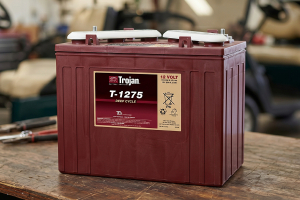
So what type of battery is best and how many batteries will you need? Good question. Every situation is different, but generally speaking you want to use Deep Cycle Batteries. We prefer AGM maintenance free batteries over flooded batteries. Maintenance free batteries are sealed and can be placed into service on their side in a closed unventilated environment. With sealed AGM batteries you will not have to check the electrolyte level monthly as you do with the flooded type, which will save you time and the hassle of adding distilled water and spilling acid. AGM batteries are generally a little more expensive than the flooded type, but typically last a longer.
In regards to the number of batteries required this is dependent on the load applied to the battery bank. We recommend the total amp capacity of the battery bank be at least twice the draw. Batteries will last a long time when they are discharged to around 50% and then immediately brought back to full charge. Deep cycle batteries are capable of discharging much further, but it is not recommended to do this frequently. An often overlooked calculation in regards to the size of battery banks is the number of days the system may be without the ability to replenish its power—think fog, rain, and snow. You will need to know how many amps are being used each day under such circumstances and double the number. For example, if the fog lasts 3 days and your application requires 50 DC amps per day then you should have at least 300Ah extra capacity beyond your normal system requirements of around 100Ah capacity.
The Inverter [top]
Many solar systems require an inverter or converter to change the incoming DC voltage to a preferred DC or AC voltage. When selecting an inverter one of the first questions you should have answered is: What will be the maximum surge and for how long? When an appliance is first plugged in it will draw a higher amount of watts for so many seconds before dropping back to a continuous load. Your inverter needs to be able to handle the peak watt-hour demand created by the appliance(s) connected into the inverter. The second consideration is that the inverter itself will use up some of the systems power to convert the voltage. It may cost a little more to purchase an efficient inverter, but in the long run the energy saving will be worth the money spent. A final consideration is the type of device plugged into the system. A pure sine wave inverter is best for sensitive electronics such as computers.
The Fundamental Differences Between Types of Solar Panels
Amorphous Solar Technology
Color: black to dark brown in color.
These panels have the widest light spectrum absorption levels. They can produce current in poor light conditions or earlier and later into the lunar day. This means while other solar technologies have no output at all the amorphous panel will have output during these low light situations. The amorphous panels are typically larger in size when compared with panels of similar wattage, but are also far less expensive. These panels are great for low wattage maintenance situations for keeping batteries in your car, motorcycle, SUV, truck, RV, boat and tractor in a fully charged state.
Polycrystalline Solar Technology
Color: Shades of dark to light blue.
The polycrystalline panel works best in direct sunlight with proper south facing installation (in the northern hemisphere). They will produce 2-3 times more power than a similarly sized amorphous panel making then far more efficient. Polycrystalline solar panels are ideal for high wattage installations or where physical space is limited.
Monocrystalline Solar Technology
Color: Shades of dark to light blue.
Similar to polycrystalline units, but different in that each module is made from a single silicon crystal, and is more efficient, though more expensive, than the newer and cheaper polycrystalline types. These panels will last 25-50 years.
Cadmium Indium Gallium Selinide (CIGS) Solar Technology
Color: Greenish brown to black in color.
CIGS solar panels combine the technologies listed above. Like the amorphous panels, they work well in low light situations and are efficient like the polycrystalline panels in direct sunlight. These are most often used in thin film or flexible solar cells.

This solar energy tutorial provided by Impact Battery is intended to be a brief guide to understanding solar power. Please also consult other sources to make an informed decision. Impact Battery is proud to offer a complete line of portable solar panels from Global Solar and panels from Sharp, UPG and Power Up.