How to Choose a Golf Cart Charger: Voltage, Plug Type and Battery Match
Taking care of your golf cart is important. Whether you use it for work, for golf, or just for fun around the neighborhood, you need it to work every time. A big part of that is the battery charger. It gives your cart the power it needs to go.
A golf cart charger is a special power box. Its job is to fill up your cart’s deep-cycle batteries safely. It has to do it the right way, so you do not hurt the batteries. When you think about how to choose a golf cart charger, you have to look at the real facts. You need to check the voltage, the battery type, the plug shape, and more..
This guide will show you everything. We will walk through each step so you can find the perfect charger for your cart. This will help your cart run great and make your batteries last a long, long time.
Identify Your System’s Operating Voltage Matching Needs
Think of voltage as the power level of your golf cart. Some carts use a lower power level, and some use a higher one. The golden rule is simple. The charger’s voltage must be the exact same as your cart's total battery voltage.
Why Voltage Matching is Crucial
This is not something you can guess. If you use a charger with the wrong voltage, you can break your batteries or even the charger itself. It is a serious mistake, but it is very easy to avoid.
Plugging a 36V charger into a 48V cart will do nothing. It will not even start charging. But plugging a 48V charger into a 36V cart is very dangerous. It will fry your batteries and could cause a fire. Always match the voltage rating.
How to Find Your Cart’s Voltage
So, how do you find your cart's voltage? You just need to do a little bit of detective work on your own cart. There are two simple methods.
Method 1: Check Your Old Charger
The easiest way is to look at the old charger you were using. The voltage number should be printed right on its label or sticker. It will clearly say 36V, 48V, or maybe even 72V. This is your magic number.
Method 2: Inspect the Batteries
If you do not have the old charger, that is okay. You can find the voltage by looking at the batteries in your cart. Your golf cart has a big battery bank made of a few smaller batteries linked together.
Step 1: Find the Batteries. Lift the seat of your cart to find the battery compartment. You will see a group of large, blocky batteries connected with thick cables.
Step 2: Find the Voltage of One Battery. Look at a single battery. It will have little caps on top where you might add water. These are called cells. Count the number of cell caps on one battery, then multiply that number by two.
Example: 3 caps x 2 = 6-Volt Battery
Example: 4 caps x 2 = 8-Volt Battery
- Step 3: Calculate the Total System Voltage. Now, count how many batteries you have in total. Multiply the number of batteries by the voltage of a single battery.
Example: 6 batteries x 6 volts each = 36V System
Example: 6 batteries x 8 volts each = 48V System
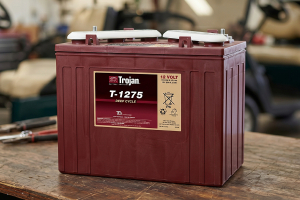
Some 48-volt systems are set up differently. They might use four individual 12-volt units instead. A great example of this is the Trojan T-1275 12V 150Ah battery. If you have four of these linked together, you have a 48V system and need a 48V charger.
Once you are sure about the voltage, the next thing to think about is charging speed. This is controlled by something called amperage.
Calculate Amperage for Ideal Recharging Turnaround Time
If voltage is the power level, then you can think of amperage as the speed of the power. It tells you how fast electricity flows from the charger into your batteries. The amperage number is always on the charger with the letter "A" next to it, like 15A or 20A.
The basic rule is simple: A higher amp number means a faster charge.
So, which speed is right for you? It depends on your battery size and how you use your cart.
How to Calculate Your Charging Time
You can figure out roughly how long it will take to charge your cart with a simple formula. You just need two pieces of information:
Your Battery’s Amp Hour (Ah) Rating: Think of amp hours (Ah) as the size of your cart's "fuel tank." A bigger number means the battery holds more power. This is usually printed on a sticker on the side of your batteries.
Your Charger’s Amperage (A): This number is printed on the charger itself.
Here is the math:
Battery Amp Hours (Ah) ÷ Charger Amps (A) = Approximate Charging Hours
Let's Look at an Example
A popular battery like the Trojan T-105 6V 225Ah has a rating of 225 amp hours. This is its fuel tank size.
Let’s see how long it would take to charge using two different chargers:
With a 15A Charger: 225 Ah ÷ 15 A = 15 hours
With a 25A Charger: 225 Ah ÷ 25 A = 9 hours
This difference in time is called the recharging turnaround time. It is the time you have to wait before your cart is ready to go again.
Which Speed is Right for You?
Do you need the fastest charger you can find? Not always.
For Most People: If you charge your cart overnight, a standard 15A to 20A charger is usually perfect. It is gentle on the batteries and gets the job done while you sleep.
For Heavy Users: If you use your cart all day for work and need a quick recharge during a lunch break, then a faster charger with a higher amperage (25A+) might be a good idea.
Just know that faster chargers often cost a little more. The key is to find the right balance for your needs and your budget.
You have figured out the voltage and the speed. Now, we need to talk about the batteries themselves. The stuff inside them really matters.
3. Align Output Rhythms with Battery Chemistry
It may sound complicated, but battery chemistry is just what the inside of the battery is made of. The two main types for golf carts are lead-acid and lithium-ion. They are very different, and they need to be charged in very different ways. This is a very important part of how to choose a golf cart charger.
Think of it like feeding a pet. A dog and a cat both need food, but you cannot give them the same kind. Your batteries are the same. Using the wrong charger for your battery's chemistry can damage them and make them wear out much faster. This is true even if you are just looking for new golf cart batteries to upgrade your old ones. The charger must match the new chemistry type.
Lead-Acid Batteries
These are the classic, heavy batteries that have been used for decades. They are reliable and cost less. But even within this group, there are a few different styles. Smart chargers often have different settings for each type.
Flooded or Wet Cell: These are the most common. They have caps on top that you can open to add distilled water. They need this regular check-up to stay healthy.
AGM (Absorbent Glass Mat): These batteries are sealed, so you never have to add water. The acid inside is absorbed in a special mat, so it cannot spill. They are great if you want less work.
Gel: These are also sealed and maintenance-free. They use a thick gel-like substance instead of liquid acid. A battery like the UPG UB-GC2 GEL 6V 200Ah needs a charger with a special setting for gel batteries to avoid damage.
Chargers for lead-acid batteries use special charging cycle algorithms. This is just a fancy term for a smart charging plan. The charger changes the power level at different stages to make sure the battery gets a full, safe charge.
Lithium-Ion Batteries
These are the newer, lighter batteries. They are becoming very popular because they last longer, charge faster, and weigh a lot less than lead-acid batteries.
Lithium batteries are very different on the inside. They have a computer brain inside them called a battery management system, or BMS. This BMS is like a security guard for the battery. It protects it from getting too much power or running too low.
A lithium battery charger must be able to talk to the BMS. It needs a special charging plan made just for lithium. You absolutely cannot use a standard lead-acid charger on a lithium battery. It will not work right and could damage the expensive battery.
So, before you buy a charger, check your batteries. See if they are lead-acid or lithium. Then, buy a charger that says on the box it is made for that exact chemistry.
On-Board vs. Off-Board Chargers: Which is for You?
Another choice you have is where your charger will be. You can get an on-board charger that is installed directly on the golf cart, or an off-board charger that is a separate, portable box you keep in your garage. Both have good points.
On-Board Chargers
An on-board charger is bolted right into the cart. To charge, you just use a simple extension cord from the wall to a plug on the cart.
Pros: It is super convenient. The charger is always with you, so you can charge your cart anywhere there is a normal wall outlet. You do not have to carry a heavy box around.
Cons: If it breaks, it can be harder to replace. It also adds a little extra weight to your cart all the time.
Off-Board Chargers
This is the traditional style. It is a portable box with a power cord for the wall and a long cable that plugs into your cart.
Pros: It is easy to replace if it stops working. You can also use one charger for multiple carts if they have the same voltage and plug.
Cons: You have to remember to bring it with you if you think you might need a charge away from home. They can also be a bit heavy and take up shelf space in your garage.
The choice is up to you. If you value convenience and often charge at different places, an on-board charger is great. If you only ever charge in one spot, a classic off-board charger works perfectly fine.
Ensure Plug Type and Hardware Compatibility
You could find the perfect charger with the right voltage and amps, but if the plug does not fit into your cart, it is useless. This seems obvious, but it is a mistake many people make. How to choose a golf cart charger often comes down to this simple, physical match.
Think about your phone. An Apple phone uses a different plug than an Android phone. Golf carts are exactly the same. Different brands use different plug shapes to make sure you use the right equipment.
Do not assume all plugs are the same. Before you even start shopping, go look at your golf cart. Find the spot where you plug the charger in. This is called the receptacle. Take a clear picture of it with your phone. Then, if you have your old charger, take a picture of the end of the plug. Now you have a perfect reference.
Here are the most common plug types you will see for the big brands:
Club Car Round 3-Pin: This is a common plug for Club Car carts. It is round and has three pins inside. It is easy to spot.
EZ-GO D-Style / TXT: This plug is for many E-Z-GO models. It is shaped like the letter D. It is rectangular on three sides with one rounded side.
EZ-GO RXV Triangle: Some newer E-Z-GO carts use this special plug. As the name says, it is a triangle shape with three pins.
Yamaha MAC / Crowsfoot: These plugs are often found on Yamaha carts. They are usually flat with two main prongs.
There are other types too, but these are the big ones. The product description for a charger will always say which cart and plug style it is for. Just match your picture to the description, and you will be all set. This simple check saves a lot of time and trouble.
Prioritize Advanced Smart Charger Safeguards
Today's golf cart chargers are not just simple power cords. The best ones are smart. They have little computer brains inside them that protect your batteries. Getting a smart charger is one of the best things you can do for your cart.
These smart features help with prolonging battery lifespan. That means your batteries will work well for more years, which saves you a lot of money. When you have a bank of batteries like the tough UBGC8 Universal Power AGM 8V 200Ah, you want to protect them.
Here are the key safety features to look for.
Automatic Shut-Off: This is the most important feature. A smart charger knows when your batteries are 100% full. When they are full, it automatically stops sending power. This provides overcharge protection. Overcharging ruins batteries.
Multi-Stage Charging: A smart charger uses a smart plan. It starts with a strong charge, then slows down as the battery gets full, and finally provides just a tiny bit of power to keep it topped off. This "float mode" is much healthier for batteries.
Thermal Overload Protection: A good charger has a heat sensor. If it gets too hot, it will automatically shut down to cool off. This prevents the charger from overheating, especially in a hot garage.
Durable, Weather-Resistant Case: Look for a charger with a strong case, usually made of aluminum. Many are also sealed with an IP rating to protect them from dust and water. This is great if your garage is dusty or damp.
These features make a huge difference. They take the guesswork out of charging and protect your expensive batteries. It is always worth spending a little extra to get a smart charger with these safeguards.
Frequently Asked Questions (FAQs)
Choosing the right charger brings up a few common questions. To help you feel confident in your decision, here are quick and straightforward answers to some of the things people ask most often when buying a new golf cart charger.
Can I use any 48V charger on my 48V golf cart?
Not always. While the voltage must match, the charger's plug must also fit your cart’s specific receptacle (like for Club Car or EZ-GO). Additionally, the charger should be compatible with your battery chemistry, whether it is lead-acid or lithium.
Is it bad to leave a golf cart plugged in all the time?
No, not if you have a modern "smart" charger. These chargers enter a maintenance or "float" mode once the batteries are full. This keeps them topped off safely, which is actually healthier for the batteries than letting them sit uncharged.
Can I use a regular car battery charger on my golf cart?
Absolutely not. Car chargers are designed for starter batteries, while golf carts use deep-cycle batteries. Using a car charger can quickly damage your expensive golf cart batteries because it uses a completely different and unsafe charging algorithm for them.
How do I know if my golf cart charger is bad?
Check for basic issues first, like if it is plugged in correctly. If the indicator lights do not turn on, or if you do not hear a click or hum when connected, it may be broken. Also, inspect the cables for any cracks or damage.
Do I need a special charger for AGM or Gel batteries?
Yes, it is highly recommended. AGM and Gel batteries are types of sealed lead-acid batteries that require a specific charging profile. A good smart charger will have a dedicated setting for AGM/Gel to ensure they are charged correctly without damage.
Ready to Power Up? Find Your Perfect Match Today
Choosing the right golf cart charger doesn’t have to be complicated. Now that you know exactly how to check your voltage, match your plug, and respect your battery’s chemistry, you’re ready to make a confident choice. A reliable charger is the best investment you can make for the health and longevity of your batteries, ensuring they perform powerfully season after season.
Don't let a weak or incorrect power system hold you back. Explore our complete selection of smart chargers and premium deep-cycle batteries to build the perfect power solution for your cart. Our experts are ready to help you find the guaranteed right fit for your ride, giving you performance and peace of mind.