What Causes Golf Cart Batteries to Lose Power? (Technical Guide)
You head out for a smooth ride on the course, expecting everything to work perfectly. Instead, the cart feels weak and slow, struggling to keep pace. That sudden drop in performance often points to a deeper battery issue.
Understanding what causes golf cart batteries to lose power helps you spot it early. Most people think a simple recharge will fix everything, but that is not always true.
Inside the battery, chemical aging, sulfation, and poor maintenance quietly reduce capacity over time. Heat, overcharging, and long storage without use also drain performance faster than expected. The result is less power, shorter rides, and frustration on the course.
The good news is that most of these issues can be managed or prevented. With the right care, your cart can regain smooth, reliable performance.
Primary Symptoms of Power Loss in Golf Cart Batteries
Recognizing early warning signs of a failing battery can save you from getting stranded. Your cart gives clear signals through its performance. If you notice changes early, you can avoid bigger problems later.
Decreased Driving Range of Golf Cart Batteries
One of the first signs is a shorter driving range. You may not make it through eighteen holes on a single charge anymore. The battery meter drops faster than usual. This happens because the battery can no longer store as much energy as it used to. Even when it shows full, the real capacity is lower. This is a common sign that the battery is not holding a charge properly.
Reduced Torque and Uphill Speed of Golf Cart Batteries
Another sign is losing power on hills. A healthy cart should climb without trouble, but weak batteries struggle. They cannot deliver enough power when it’s needed most. As a result, the cart slows down or feels weak on inclines. Getting over steep terrain requires a high-capacity cell that can handle heavy amperage draws without flinching.
Slower Acceleration and Lagging Response from Golf Cart Batteries
You may also notice the cart feels slow to start. When you press the pedal, it doesn’t respond right away. This usually happens when the batteries have higher internal resistance. The energy is still there, but it cannot flow quickly enough. The cart takes longer to reach normal speed, even on flat ground.
Premature Discharge and Rapid Voltage Drop in Golf Cart Batteries
Another clear sign is a sudden drop in power during use. The meter may fall quickly from full to empty when you accelerate. This often means one or more cells inside the battery are failing. Even if the battery looks fine at rest, it cannot hold up under demand. This sharp voltage drop usually means the battery is nearing the end of its life.
Internal Chemical Failures Impacting Golf Cart Battery Strength
Your battery works like a small chemistry lab. When balanced, energy flows smoothly, but over time, reactions can go wrong and cause damage. These internal issues are the main reason golf cart batteries wear out. Understanding this helps you prevent damage and extend battery life.
Lead Plate Sulfation in Aging Batteries
Sulfation is a leading cause of battery failure. Small sulfur crystals form during use and usually dissolve when recharged. But if the battery stays discharged, they harden and stick to the plates, blocking normal energy flow.
As the buildup increases, the battery loses capacity and struggles to hold a charge. Once the plates are too far gone, swapping to a cost-effective battery is often the only way to get your cart moving again.
Electrolyte Evaporation and Low Water Levels
Batteries “breathe” while charging, releasing small amounts of oxygen and hydrogen gas. Over time, this lowers the water level inside the battery. If the water gets too low, parts of the lead plates are exposed to air. Even a short exposure can cause permanent damage inside the battery.
Keeping the correct water level helps the battery stay stable and run cooler. Always use distilled water, since tap water has minerals that can reduce performance. Keeping the plates fully covered is one of the easiest ways to extend battery life.
Feature | Healthy Battery | Damaged Battery |
Water Level | Above Plates | Plates Exposed |
Liquid Type | Clear Electrolyte | Cloudy or Low |
Plate Color | Grey or Brown | White or Crystalline |
Voltage at Rest | 12.6V+ (Per 12V) | Below 10.5V |
Acid Stratification Issues in Deep Cycle
Acid stratification happens when acid sinks, and water rises inside the battery, causing uneven charging. This can lead to corrosion and sulfation. It’s common in unused or lightly charged carts, and an equalizing charge helps correct it.
Internal Resistance Buildup in Failing
Resistance acts like friction for electricity. As a battery ages, internal friction increases inside the cells, causing more energy to turn into heat instead of power. That heat reduces performance and leads to the power dropping after a few minutes of driving.
The cart starts strong, then quickly weakens as current flow becomes restricted. This is a clear sign that lead-acid batteries are wearing out.
Electrical System Bottlenecks That Drain Golf Cart Battery Power
Sometimes the batteries are fine, but power still doesn’t reach the motor. The wires and connectors act like pipes for electricity. If those pipes are loose, corroded, or damaged, performance drops quickly.
This is why checking connections is an important part of maintenance. Many hidden power losses in golf cart batteries start right here, quietly reducing performance.
Corroded and Loose Terminal Connections
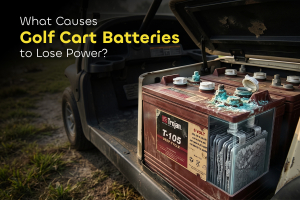
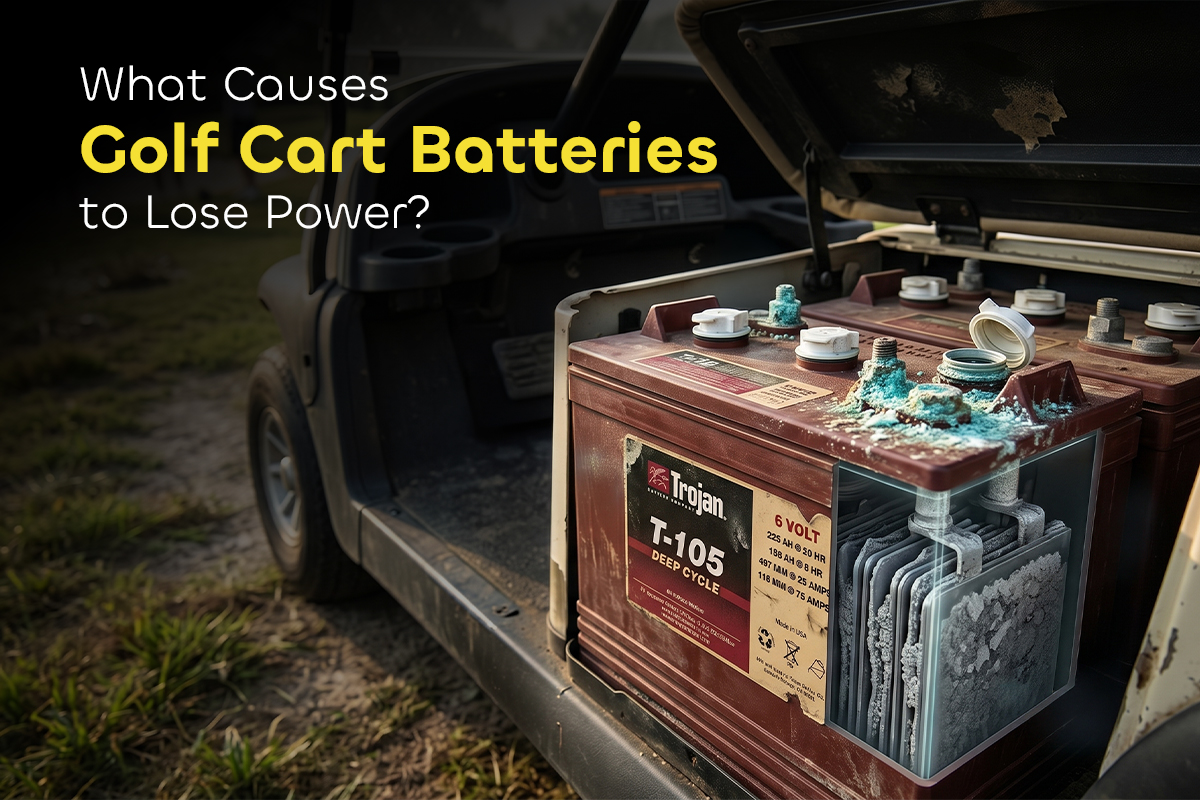
Corrosion on battery terminals shows up as blue or white buildup. It blocks electricity flow and can cause a voltage drop at the motor. Clean terminals regularly using water and baking soda to remove buildup and neutralize acid.
Make sure all connections are tight. Loose terminals can cause arcing and damage the posts.
Supplies needed: Baking soda, wire brush, distilled water, and terminal protectant spray.
Action: Scrub until the lead is shiny and clean.
Result: Instant restoration of your lost torque.
High Resistance in Damaged or Undersized
Battery cables must be thick and in good condition to handle the load. Factory cables are often thin and can degrade over time, sometimes showing a green tint inside.
This corrosion increases resistance and reduces power to the motor. Upgrading to 4-gauge cables can improve performance by allowing better current flow.
Malfunctioning Speed Controllers and Solenoids
The speed controller manages how much power goes from the batteries to the motor. If it fails, it can limit power even when the batteries are fully charged.
The solenoid is a heavy-duty switch. If its internal contacts are worn or burnt, it can block power flow and cause loss of performance after charging. Both parts are important in the system and should be tested if power issues occur.
On-Board Computer (OBC) Faults Restricting Golf Cart Battery Charging
Many Club Car models use an OBC to control charging. It tracks energy use and tells the charger when to stop. If it fails, it may end charging too early. The meter can show full, but the batteries may only be half charged.
You may face a “full but no power” issue. Testing or bypassing the OBC can help identify if it is causing the problem.
Environmental and Storage Factors Affecting Golf Cart Battery Capacity
Nature can be tough on lead-acid chemistry. The environment around your cart plays a huge role in how much energy is available. Whether it is a heatwave or a cold winter, the weather is always working against your battery pack.
Let's look at how the outside world impacts your internal power:
Thermal Degradation of Golf Cart Batteries During Extreme Heat
Heat makes chemical reactions happen faster. This sounds good, but it actually wears the battery out. High temperatures cause the water in the electrolyte to evaporate. It also speeds up the corrosion of the internal plates.
If you live in a hot climate, your golf cart batteries will naturally have a shorter lifespan. You must check the water level much more often in the summer to prevent permanent damage.
Self-Discharge Rates of Golf Cart Batteries in Cold Weather Storage
When the temperature drops, the chemistry inside the battery slows down. A cold battery cannot give up its energy as easily as a warm one. This is why you feel a loss of zip during the winter.
Even worse, a discharged battery can freeze and crack the case. During off-season storage, you should use a trickle charger to maintain a high state of charge. This prevents the battery from sitting at a low voltage, which can cause deep-discharge damage.
Parasitic Draw from Accessories on Idle Golf Cart Batteries
Modern carts often have radios, lights, or GPS units. If these are wired directly to the batteries, they can cause a parasitic drain. This is a slow "leak" of energy that happens even when the key is off.
Over a week, this parasitic draw can pull the batteries down to a dangerously low level. If you leave your cart for a few days and find it dead, check for parasitic draw with a multimeter. It is often a forgotten accessory that is stealing your power.
Diagnostic Steps to Identify Failing Golf Cart Batteries
You don’t need to be a mechanic to spot a bad battery. With simple tools, you can test your system, save money, and identify weak batteries before replacing anything.
1. Real-Time Load Testing of Golf Cart Batteries During Acceleration
A battery can look healthy when the cart is sitting still. The only true test is a load test. You can do this by connecting a multimeter to the battery pack and driving up a hill.
Watch for a voltage drop under load. If the voltage crashes the moment you hit the pedal, the batteries are failing. This voltage drop test is the most accurate way to see how the cells perform in the real world.
System Voltage | Full Charge | 50% Charge | Replace If Below (Under Load) |
36V System | 38.2V | 35.9V | 28.0V |
48V System | 50.9V | 47.9V | 38.0V |
2. Specific Gravity Testing of Individual Golf Cart Battery Cells
If you want to know the "truth" about a battery, check the acid. A hydrometer measures the specific gravity of the liquid inside. Each individual cell should have a similar reading.
If one cell is much lower than the others, you have found a dead cell. Learning how to use hydrometer tools is an essential skill for any cart owner. It tells you exactly how much energy each cell can physically hold.
3. Individual Cell Voltage Variance in Golf Cart Battery Packs
In a series connection, one weak battery will ruin the whole group. Use your multimeter to check each cell or individual battery. If you have five batteries at 8.2 volts and one at 7.1 volts, that one bad battery in pack is your problem.
It creates a bottleneck for the entire system. You will experience losing power after charge because the weak battery is dragging the others down. Always test individual battery voltage before deciding to replace the entire set.
4. Visual Inspection for Bulging and Leaking in Golf Cart Batteries
Sometimes, the eyes are the best tool. Look at the sides of the battery cases. If they are bulging or "pregnant," it means the battery has overheated. This is often caused by thermal runaway or overcharging.
Check for leaks or wet spots on the garage floor. A leaking battery loses electrolyte, which means it loses power. If you see physical damage, it is time for a replacement.
Troubleshooting And Maintenance Solutions to Restore Golf Cart Battery Performance
If your batteries are not too far gone, you might be able to save them. A little bit of battery maintenance goes a long way. These steps can help reverse minor damage and keep your cart running strong for many years. Let's look at the best ways to fix the energy flow.
Equalizing charge: A controlled overcharge that helps break up sulfur buildup and rebalance the battery. Many chargers include this feature, and using it about once a month can improve performance.
Proper water refilling: Add distilled water only after charging is complete. This helps avoid overflow and keeps the internal chemistry stable.
Seasonal storage care: Before storing your cart, fully charge the batteries and disconnect the cables. Using a trickle charger can help maintain a charge and prevent damage during storage. If your current pack is beyond recovery, investing in a time-tested battery solution makes sure you won't be repeating these troubleshooting steps next season.
Frequently Asked Questions (FAQs)
The chemistry and wiring in a golf cart battery can seem complicated, but the basics are easier than they look. Here are some clear answers to help you take better care of your golf cart batteries right away:
Why do my golf cart batteries lose power when going up hills?
Going up hills needs a huge burst of amperage from your pack. If your lead-acid batteries have high internal resistance, a golf cart battery low voltage issue will come up. This causes the motor to struggle. It usually means your battery plates are sulfated and very weak.
How often should I check the water in my golf cart batteries?
You should check your water level once a month. Heat causes electrolyte to evaporate fast. In the summer, check every two weeks. Always add distilled water to keep the lead plates covered. A low water level leads to permanent internal plate damage very quickly now.
Can I replace just one dead battery in a golf cart battery pack?
It is best to replace the whole pack at once. Mixing a new unit with old lead-acid batteries causes a charging cycle imbalance. The old batteries will drag the new ones down. This leads to premature battery wear and a much-reduced driving range.
Why does my golf cart run slowly even though the batteries are fully charged?
This is usually a voltage drop under load. Your batteries may show a full charge at rest. But they lack the depth to carry weight. It could also be a bad battery cable or a failed speed controller restricting the flow of your available amperage.
How do I know if my golf cart batteries are sulfated?
If your cart has a reduced driving range, the battery plates are sulfated. You will notice much longer charging times as well. Use a hydrometer to check each cell. If the specific gravity is low even after a full charge, your internal chemistry is failing badly.
What is the best way to clean golf cart battery terminals?
Use a mix of water and baking soda to clean the battery terminals. This neutralizes acid and stops corrosion. Scrub with a wire brush until you see shiny metal. Tighten any loose terminal connections to prevent voltage drop or lead-post melting.
Ready To Stop Golf Cart Batteries From Losing Power
Your golf cart starts strong, then slowly loses power. It struggles on hills, needs frequent charging, and feels unreliable. That gets frustrating fast.
Most of the time, the issue is not the battery itself, but poor maintenance habits. Small mistakes add up and reduce performance over time.
Understanding what causes golf cart batteries to lose power comes down to consistency. Charge after every use. Clean terminals. Check and refill water levels. Perform equalizing charges and test batteries regularly.
Keep connections tight and cables clean. Follow these basics, and your cart stays dependable and ready.