What Are the Signs Your ATV Battery Needs Replacing?
The spring is in the air. The summer is drawing close. Time to gear up on your ATV, fire up your adventurous spirit, and set out to drift across the rugged terrain. But before you pull it onto the road, make sure the ATV actually sparks to start. There is a high chance the winter cold has dampened the battery.
A battery does more than trigger the ignition. In the latest ATVs, they run fuel injectors and soften the AC flow produced in the stator. A dying one may lead to a sudden stop in the middle of a race or in no man’s land.
By now, you must be wondering, “What are the signs your ATV battery needs replacing?” We have you covered here, revealing ways to mark a weak cell. You will also get strategies to measure its condition.
Why Your ATV Battery Must Be in Good Shape?
Your ATV battery must be in good shape because it provides the power needed to start the engine, operate lights and accessories, and maintain reliable performance. A weak or failing battery can cause starting problems, reduced electrical performance, and unexpected breakdowns on the trail.
Yours may be a sport ATV. To keep it light and swift, it doesn’t use a winch or an electric power steering (EPS). But the need for a strong force to kickstart the shaft is always there.
For advanced models, a battery is like a heart that constantly feeds the fuel to the engine. They always come with a default EPS, making electricity even a graver necessity.
Without a steady power, sensors and fuel injectors in modern ATVs start to blink. The steering gets heavy and may jerk while making a turn. You’d better purchase a Hybrid AGM battery if you have already faced such things.
Moreover, you don’t want your stator overworked. It results in added heat and friction, which later takes a toll by melting the wires inside your engine. The payback is a hundred times costlier than replacing the battery.
What Are the Signs Your ATV Battery Needs Replacing?
An ATV battery rarely fails without warning. In many cases, it shows several signs of wear before it completely stops working. Recognizing these warning signs early can help you avoid being stranded on a trail or dealing with unexpected starting problems.
One common indication of a weakening battery is slower engine cranking. If your ATV takes longer than usual to start or sounds sluggish when turning over, the battery may no longer be holding a full charge. This problem often becomes more noticeable during cold weather when batteries are under greater strain.
Dimming headlights and weak electrical accessories can also point to battery issues. Lights that appear less bright than normal or accessories that operate inconsistently may indicate that the battery is struggling to supply sufficient power. In some cases, the battery may charge temporarily but lose its charge quickly after use.
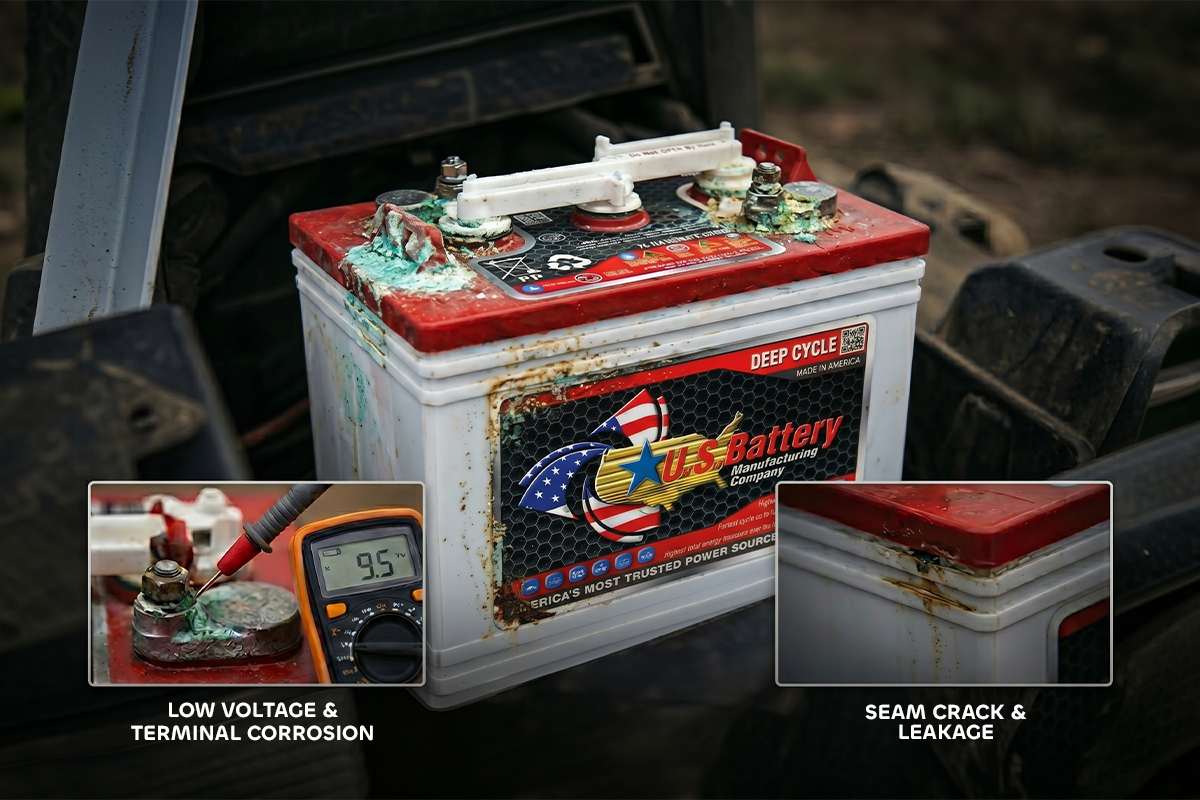
Physical signs should not be ignored either. Corrosion around the battery terminals, swelling of the battery case, cracks, or leaks can all suggest that the battery is nearing the end of its service life. These issues can affect performance and potentially damage other electrical components.
Another warning sign is the need for frequent jump-starts or recharging. A healthy ATV battery should maintain its charge during normal periods of use. If you constantly need to recharge the battery or use a jump starter, it may no longer be functioning efficiently.
Battery age is another factor to consider. Most ATV batteries have a limited lifespan, and performance naturally declines over time. Even if the battery appears to work, older batteries are more likely to fail unexpectedly. Regular inspections and voltage testing can help determine whether replacement is necessary before problems become more serious.
8 Warning Signs Your ATV Battery has Had Too Much
Save yourself from the "dead in the dirt" scenario. Make an eye for red flags and respond fast when you see one. Here are ATV battery issues you should be looking out for:
1. The Slow Crank: The Cry for Help
Listen closely when you press the start button. If you hear a slow, rhythmic "urr... urr... urr" instead of the engine’s regular bark, pay attention. Probably your battery is crying under the weight of high current.
The Sound: Not dry or suppressed, but a whooping clank pushed through a pipe.
The Feeling: After every stir, the starter button would feel stuck and take a few seconds before becoming triggerable again.
Cold Weather Impact: This sign shows up most often on frosty mornings.
The Culprit: The lead plates inside are likely coated in sulfur crystals, blocking the flow of power.
2. The Rapid-Fire Clicking
If your battery clicks like a "machine gun," it’s not getting enough juice to turn on the engine. The relay closes, the engine demands power, the voltage drops, and the relay snaps back open. This cycle repeats fast.
It is a loud, clear cry for help. If you hear this, do not keep holding the button. You can actually weld the relay shut or burn out the starter motor. This is a sign that your battery voltage is persisting below 10 volts under load.
3. Longer Recovery Time
Your ATV produces a limited amount of power. Accessories like winches, heated grips, and LED bars eat that power fast. Though it’s highly unlikely to happen with an AGM Lithium unit. As it absorbs big hits, shields the current energy level, and recharges quickly.
But when your battery is dying, it may still maintain a stable flow until it’s challenged. But it will struggle to kick back to its full strength once the power drops. Common symptoms are heavy steering after pushing out of a hole, and flickering lights and panels.
4. Case Bulging and Bloating
Look at the battery case. It should have straight, flat sides. If the plastic looks swollen, you are overcharging for a long time. Gas produced by overheating has gathered inside the cell.
Take a bulging battery for a ticking time bomb. It can explode and spray hot acid on the spur of the moment. Replacing it with a deep cycle battery would be wise. They are made able for swift charging and discharging.
5. Low Resting Voltage
Also known as static voltage. It’s like a full-body medical report for your battery. On the multimeter, expect a reading between 10.0V and 14.0V. Anything higher, and lower is a solid disaster.
12.6V to 12.8V: This is a healthy, fully charged battery.
12.4V: This battery is at about 75% capacity and needs a charge.
12.0V: This battery is effectively dead and is likely damaged.
11.8V or lower: The battery is toast.
6. Oxidation and Corrosion
Open the battery compartment and look inside. A corrosion will look like a white or blue-green powder. If the buildup has come to the point of "leaking," nothing is a worse sign.
It often means the seal around the metal post has cracked. Acid vapors are seeping through and eating the metal. If not replaced with a compatible sealed power AGM battery, the leaking cell will eventually damage your expensive wiring.
7. Smell of "Rotten Eggs"
Your nose is a great diagnostic tool. If you pull into the garage and smell something like a swamp or rotten eggs, check the battery. This scent is hydrogen sulfide gas, made by boiling electrolytes.
The liquid turns into vapour, keeping the battery essentially wet. You may let it pass, but it won’t come to any help. As it will dry out the setup and spoil it completely. Only a sealed AGM unit can be of help. As they are made to be leakage-proof and also contain flammable gases safely within.
8. Frequent Meter Resets
Does your clock always say 12:00? Do your trip meters reset to zero every time you start the engine? This falls among the bad ATV battery signs. When you hit the starter, the battery voltage drops so low that the computer loses its memory.
It might only last for a millisecond. It is just enough to "reboot" the screen. This is a clear indicator that the battery has no "reserve capacity" left. It is giving everything to the starter and leaving nothing for the brain of the machine.
Identifying the Problem: Catching it Red Handed
As the famous saying goes, “Correct diagnosis is three-fourths the remedy.” An incorrect diagnosis can also lead to worse results. To find ATV battery failure, collect evidence to clear all doubts. Here are some methods recommended by most experts:
A Multimeter Test: Check Your Battery’s Pulse
At twenty dollars, a multimeter is perhaps the best tool you can buy as an ATV owner. The tool is versatile and incredible in mapping your battery’s heartbeats. Here’s the simplest way to do it:
Step 1: Static Voltage Test (Engine Off)
A static voltage says how your battery is doing when at rest. So you can easily forecast its lifespan. Set the meter to DC in the 20V range. The engine must be turned off to remove stress. Touch the red lead to the positive and the black to the negative. Ideally, a fully charged cell should not mark below 12.6V.
Step 2: The Load Test (During Cranking)
Now it’s time to test your battery’s condition under stress. Join the leads of the meter to the right caps. Carefully observe its screen while kicking the engine to start.
Keep the leads on the battery. Watch the screen while you hit the start button. The voltage will drop. This is normal. But it should not drop below 9.6V. If you see the numbers plummet to 7V or 8V, the battery lacks the "muscle" to turn the engine. It is time for a replacement.
Step 3: The Charging System Test (Engine Running)
Start the engine and let it idle. Rev the engine to about 3,000 RPM. Your meter should read between 13.8V and 14.5V. If the number stays at 12V, your stator or regulator is broken. If the number climbs above 15V, your regulator is "frying" your battery.
The "Ghost Drain" Test (Parasitic Draw)
Sometimes, something is "eating" your battery while the key is off. This is common if you added a fancy light bar or a winch. To test this, disconnect the negative battery cable. Set your multimeter to "mA" (Milliamps).
Touch one lead to the battery post and the other to the disconnected cable. With the key off, you should see almost zero draw (less than 10-20mA). If you see a high number, start unplugging your accessories one by one. When the number drops, you have found your thief.
What Causes ATV Batteries to Fail?
It’s time to look behind your battery’s lead and uncover the cause of its illness. It will help protect the next one from similar damage.
Vibration and Mechanical Shock
ATVs are designed to jump, slide, and rattle. The thin lead plates inside the battery? They use plastic staff to stay in their place. Constant vibration can shake these plates loose. When two plates touch, it creates an "internal short." One second, your battery is fine; the next, it is a paperweight. This is why buying a "High-Vibration" rated battery is worth the extra cash.
Heat vs. Cold: Debunking the Myth
Most people think winter kills batteries. That is only half true. Heat kills the battery; cold just reveals the dead body. High summer heat causes the liquid inside to evaporate. It also speeds up the chemical reaction that eats away at the internal lead.
By the time winter rolls around, it also takes the battery’s soul away with it. The cold makes the oil in your engine thick, and the battery simply doesn't have the strength left to move it.
Deep Discharge Cycles
A standard lead-acid battery is like a rubber band. You can stretch it a little bit, and it snaps back. If you stretch it too far, it stays deformed. If you leave your lights on and drain the battery to 0%, you have "stretched" it too far.
A layer of hard sulfur crystals forms on the plates. This is called sulfation. Once these crystals harden, they do not dissolve. They act like a plastic wrap over the lead. No matter how long you charge it, the power cannot get in. Even one "deep death" can ruin a brand-new battery.
How to Choose the Right Replacement ATV Battery?
Choosing the right replacement ATV battery starts with checking your owner's manual. The battery must match the recommended voltage, size, and terminal configuration to ensure proper fitment and performance. Installing the wrong battery can lead to starting issues and electrical problems.
Battery type is another important consideration. AGM batteries are popular because they are maintenance-free, durable, and resistant to vibration. Traditional lead-acid batteries are usually more affordable, while lithium batteries offer lighter weight and longer lifespan.
You should also pay attention to the battery's cold cranking amps (CCA). A higher CCA rating provides stronger starting power, especially if you ride in colder weather conditions. Always choose a battery that meets or exceeds your ATV manufacturer's requirements.
Capacity is equally important. The amp-hour (Ah) rating indicates how much energy the battery can store. A suitable capacity helps power accessories and ensures reliable performance during long rides or demanding conditions.
Finally, buy from a reputable battery brand with a solid warranty. Quality manufacturers often provide better durability, consistent performance, and longer service life. Investing in the right ATV battery helps reduce breakdowns and keeps your machine ready for every adventure.
Frequently Asked Questions (FAQs)
An answer to the right question can solve a problem. Here, we have picked and answered some of the most relevant and common questions about ATV batteries:
Can I use a car battery charger on an ATV battery?
Not always. Most car chargers pump out 10 or 20 Amps. Which is too much for typical 2-Amp ATV batteries. The shock will feel like thunderstrike, and the overheat will melt the small plates in the battery in minutes.
Why does my battery die only in the winter?
Cold slows down a battery. At 0°F, a battery loses about 50% of its normal power.
Can I jumpstart an ATV from a running car?
Risky but possible. Thrusting an ATV with massive shocks can send it beyond repair. Use only the plain battery power while keeping the car’s ignition off.
How long should an ATV battery last?
With a smart charger and clean terminals, you should get 3 to 5 years. If you ignore it and let it sit all winter, you will be lucky to get two seasons.
Is it okay to have a dim headlight-ATV issue?
A washed-out headlight is nothing more than a showpiece. And often, a victim of a tired battery. Consult an expert before it goes completely off.
What if the engine starts but can’t reach its peak?
A battery can stop your ATV from reaching the last digit of its speedometer. Maybe it’s simply aged, has grown clogged, or is connected loosely. Somehow, its output is too feeble to put the engine on steroids.
Get a Battery Irreplaceably Strong
Don’t lose a good day for a fun ride to a waning cell. Have one less problem to worry about, as our range of batteries has your back. From sealed lead-acid to lithium AGM, we offer something for all ATV types.
Find one to not just fill the old cell’s shoes. Also, to drive undisturbed. At Impact Battery, we don’t let you rethink your choice. Just match the specification, and we promise you the longest-lasting battery life.