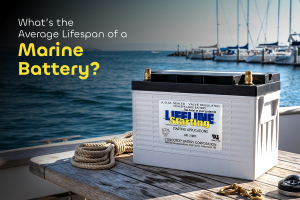
What’s the Average Lifespan of a Marine Battery?- Protection and Maintenance Guide
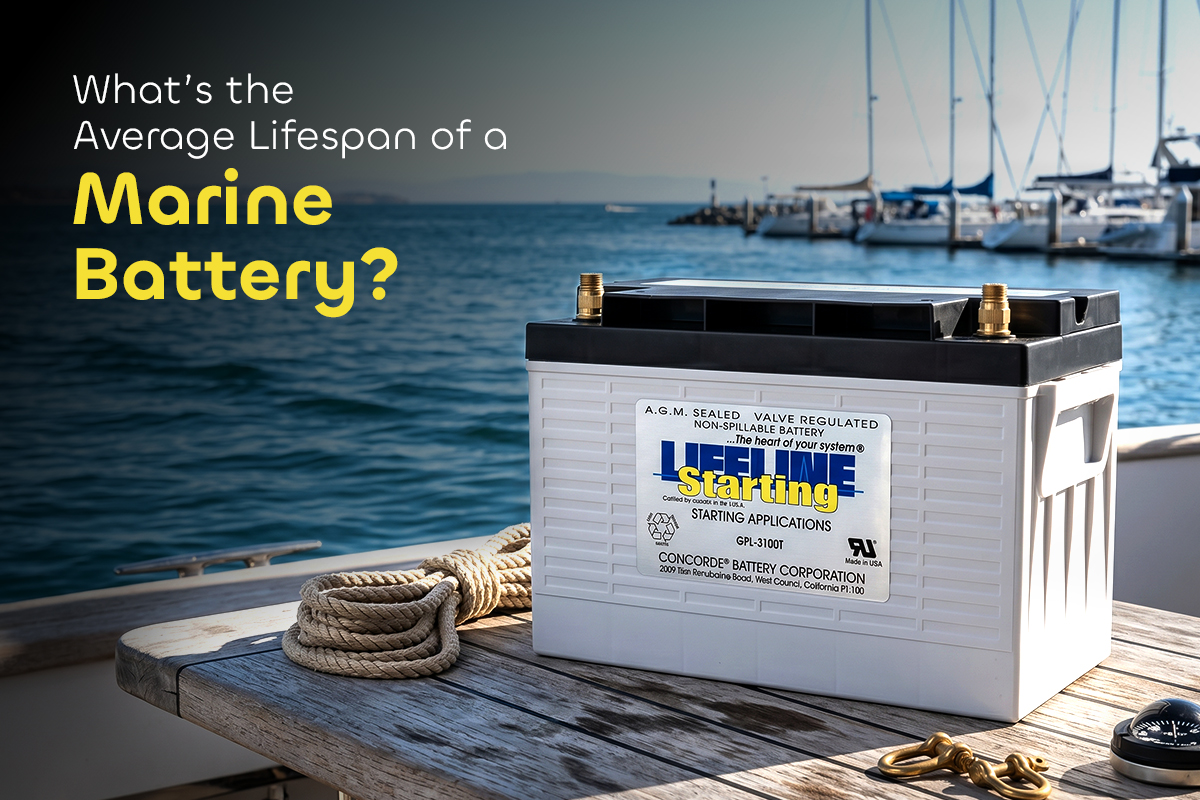
Marine batteries can last from a couple of years to even a decade. The duration is set by the battery’s type, design, price, discharge cycle, and how it's treated. Whether you are seeking a new battery either to replace the old one or for backup, the best option is also the most durable.
What’s the average lifespan of a marine battery? Why do some batteries dry out fast? Is there any way to extend a battery’s life? These are questions that haunt every boat owner. Let’s dig into their answers.
What Determines a Marine Battery’s Lifespan?
Can a marine battery last 10 years? The answer to this simple question depends on several factors affecting battery life. From cell architectures, electrolyte states, and discharge cycles, to protective measures and prices.
Battery Type
Batteries for sea-goers vary widely in purpose, capacities, core materials, and longevity. Boat engines are becoming advanced and demanding more powerful cells. Lithium-ion batteries are the answer to the high demand of modern vehicles. Lead-acid systems are still popular for their familiarity among boat owners.
Propulsion System
About 80.6% of propellers are traditional outboard or inboard types. Diesel and gas turbines are consistently trusted among most drivers. But electric propulsion is making its move with the International Maritime Organization’s (IMO) eco-saving policies in place. A battery’s life can be short or long based on the type of turbine it’s attached to.
Depth of Discharge (DoD)
DoD is the percentage of a battery’s capacity that you can use without harming its health. It’s the recommended usage limit. A 100Ah cell with a 20% DoD range works best and for seasons if you don’t squeeze more than 20Ah out of a cycle. Forcing beyond the DoD limit usually shortens a battery’s life.
Additional Demands
Luxury and trolling vessels have appliances, like refrigerators, communication tools, spotlights, indoor lighting, and fishing gear. They need to be turned on and remain usable even when the engine is offline. This demands extra power from the power unit and causes a faster burn.
Elemental Resistance
Maritime adventure involves surfing high waves, fighting with salt water, and safeguarding against humid air. Refillable batteries are prone to catching dust around corkscrews and leaking gases through the resulting crevices. So, sealed or unsealed, liquid or solid state, these factors make a decisive difference in a battery’s life.
Price
A battery’s price reflects its manufacturing precision, quality, ability, and, of course, durability. Between two models with similar specs but varied price tags, the expensive one has a higher survival rate. The difference mostly goes into refined material usage and overall architecture.
Average Lifespan of a Marine Battery: By Type, Condition, and Price
How long do different types of boat batteries typically last? The collection of marine batteries is pretty large and classified into several categories. Each category shows a quite distinct life cycle. Here is a detailed overview of the matter:
Lifespan of Types of Marine Batteries
A battery’s life depends on the type, and there are quite a few. Some have harder thrusts and exhaust easily. While some linger through seasons and keep delivering seamlessly.
Starter/Cranking Battery: A marine cranking battery moves an engine’s flywheel until it reaches the starting momentum. The force involved is measured in Cold Cranking Amps (CCA). A single spark can supply as high as 450 CCA to 1500 CCA. They have a typical lifespan of 3 to 5 years.
Deep Cycle Batteries: About 48.1% of batteries sold today are deep-cycle batteries for extended support. They offer heavy, steady, and patient delivery for about 5 to 10 years. A good deep-cycle lets you use up to 80% of its charge in every cycle without getting stressed out. Perfect for long voyages and modern marine vehicles.
Dual-Purpose Batteries: A dual-purpose or hybrid cell is the sweet spot between a starter and a deep-cycle. They can burst out a load strong enough to kickstart and hold the output steady till the end. Reasonably, they live longer than cranking and less than deep-cycles, about 3 to 6 years.
Much of a battery’s life depends on its inner mechanism, chemical ingredients, and packaging. You must have heard of categories, like:
Flooded Lead-Acid: Liquid sulfuric acid and lead plates are tanked to produce low to high-voltage current. The majority of sea vehicles use flooded lead-acid batteries due to their compatibility and easy refueling. Dealt well, and a single cell can go for at least 3 to 5 years.
Gel Marine Batteries: A lead-acid variant with silica gel that solves leakage and toxic bubbling issues. The added stability results in a longer life, deeper discharge, and higher output. They usually last from 5 to 8 years.
Absorbed Glass Mat (AGM): Still lead-acid, but instead of having free liquid or gel, they use a fiber sponge mat soaked in acid. It removes noises like spillage, vapor, and daily maintenance. The life of an ideal AGM battery spans 4 to 7 years.
Lithium-Ion: Compact and flexible, these cells use lithium as electrolytes separated between two leads. A powerful lithium-ion battery offers higher storage capacity and can store high volumes of Amp within a small container. Revolutionizing the tech field, they usually sustain about 4 to 10 years.
Lifespan of Batteries Based on Price
When it comes to performance and durability, the price is always a key determinant. The average price spectrum of Marine batteries spans from $100 to $1200, which can be categorized into:
Low-Budget Marine Batteries: Basic units designed for old engines and hence, the cheapest of all. You can buy one for around $100 to $200. They offer fewer cycle counts than other options and burn out within about 3 to 5 years.
Mid-Budget Marine Batteries: Mostly deep cycles and available in the $150 to $400 price range. Designed for longer hauls than Lead-Acids with cycle counts of 400 to 800. They typically take 4 to 7 years before becoming obsolete.
Premium Marine Batteries: This high-value segment surpasses all other types in sustainability and performance. They can run for about 10 to 15 years at a stretch, even in harsh conditions, and for 2000 to 5000 cycles. They cost between $500 and $1400.
Battery Type | Price | Lifespan (Years) | Cycles |
Flooded Lead-Acid | $100-200 | 3-5 | 300-500 |
AGM | $200-500 | 4-7 | 400-800 |
Lithium LiFePO4 | $500-1400 | 10-12+ | 2000-5000+ |
Common Reasons for Marine Battery Failure
Batteries, even coated in steel, are not as strong as they look. They need protection from the weather, care to be clean and active, and attentive handling to be at peak performance. A lasting cell is usually a well-treated cell. Let’s understand the many ways a battery may become futile:
Improper Charging Setup
It can be an incompatible charger of a lower or higher voltage output. Also, a cold, humid, or heated room where you recharge the battery at night. A loose connection to the charging port, a grid with wavering current, or wiring faults. These lead to overheating, system malfunction, and degraded DoD.
Misfit Battery Type
A deep cycle, no matter how powerful, won’t fit a small boat or even a Jet Ski. As it can’t master the needed initial crank load. Likewise, a Yacht, with just a cranking unit installed, will only go so far. It has a deck full of electronics to power up. A wrong fit drives vehicles to use up more of a battery and kill it prematurely.
Harsh Marine Environments
Saltwater and wet air are lethal to metal and chemical hardware. They tamper with sealings, wear out case surfaces, and spoil ionic equilibrium. Electrolytes lose their rawness after shifting from the day’s heat to the night’s cold rapidly and repeatedly. A battery must have a resistance mechanism in place to shield against the impact.
Limited Shore Charging Infrastructure
Only a few shores manage docks by regulations. Even fewer offer charging equipment to restore sea-returned vessels. The main power supply in coastal areas is often irregular and jumps between voltages.
What Maintenance Tips for Longer Lasting Marine Batteries Work?
Looking to know the best practices for extending boat battery lifespan? Here are the expert guidelines:
Recharge after use
Taking your vehicle out on repeat without recharging the battery is a bad habit. When electrolytes sit half-charged, they lose balance and reactivity. Keep doing it for a long time, and it will have a permanent impact. An internal cell crash is the worst-case scenario.
20/80 Rule for Marine Batteries
It’s a rule to define the secured State of Charge (SoC) level. Loading the tank to 100% often ends up in overcharging and overheating. While lingering below 20% can eat away half the cycle life. The range between 20% and 80% marks the safest, and it’s where you want to keep your battery to get the highest cycles.
Switch to Dock Resources
If possible, opt for the dock grid without relying solely on your battery. You will find a full set of marine-rated boards, switches, and connectors in the market. An inverter will bring more ease to your life, as they prevent an uncontrolled influx from ever reaching the charging port.
Test Starting Capacity
A sound battery should be able to hold a voltage above 10V and about 50% of its CCA for at least 15s. A digital multimeter will enable you to measure most input and output readings. Diagnosis, once or twice a week, will help you avoid a surprise power loss or a cell acting unusually when you need it the most.
Use a Battery Management System
It’s best to buy batteries with a battery management system. It monitors voltage and temperature, controls inward and outward flow, and protects from overcharging and heating.
How do I Know If My Marine Battery Needs Replacing?
How to tell if a marine battery is bad? Here are the signs a marine battery is failing and needs replacement:
Failed Crunks: These are the coughing sounds an engine makes instead of coming alive after you twist the key in the ignition hole. The jolt from the battery is weaker than it takes to start.
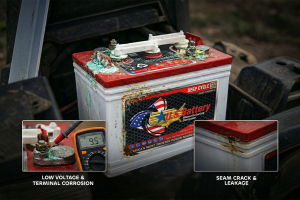
Bloated Cases: A bulge is often the result of charging at inconsistent voltage. Overheating increases gas production, which fills up inside. It pushes the outer shell out and over time, creates a bloat.
Slow Recovery: It’s easy to notice when recharges take longer than usual. If the grid didn’t lose its voltage, you need to measure the intake rate. Maybe electrolytes are losing their polarity. If so, a replacement is the only option at your hand.
Corroded Wiring: Acid gases, escaped through leakages, dissolve metal posts and covers. You may see white or blue-green powders sprinkled across the top surface. Soon, it may affect the wires and junctions and lead to short circuits.
Damaged Appliances: Fused lights, damaged freezer compressor, blinking displays, and weak pumps are power-failure issues. Electric appliances need a constant flow to stay well.
Static Voltage: Find an ammeter and connect it when the engine is shut down. A healthy reading will be between 12.6V and 12.8V. Below 10V is a call for an immediate replacement.
Frequently Asked Questions (FAQs)
Batteries can trigger a lot of questions, especially when it’s dying. Here we answer a curated list of queries from people curious about their battery’s lifespan:
What is the typical lifespan of a marine battery used in boats?
The marine battery market is shifting fast, with more companies making powerful units for commercial vessels. You can expect a marine battery to last between 3 to 5 years on average.
What Factors Reduce Marine Battery Life?
A battery’s life is the result of the precision of its design, the purpose it serves, the engine it supports, and the rate it burns at daily.
Which brands offer marine batteries with the longest average lifespan?
Odyssey, NorthStar, LifeLine, Xpedition, and MotoBatt are among the World’s best marine battery manufacturers. In our curated gallery, you will find all the trusted models from these companies.
Do marine batteries go bad if not used?
Self-draining is a common issue for unused cells. Parasitic discharge, sulfation, and rapid cool-down after a summer hibernation become frequent. Old, worn-out cells need careful treatment if you want them to haul through another season.
Should you charge a deep-cycle battery after every use?
Most experts encourage charging regularly and recommend it after every use. Lithium-Ions, though, offer some flexibility as they are almost immune to the negative effects of partial charging. It’s Lead-Acid that you shouldn’t leave half-charged for long.
Sail with an Enduring Marine Battery
In the middle of the ocean, nothing shocks more than a dead battery. Without a backup, a radar becomes lifeless, a radio goes silent, a refrigerator can’t frost, and lights remain off. If a boat is far from the shore, it can mean death to passengers.
At Impact Battery, we know the stakes of traveling with a dying unit. On our shelves, we showcase only the batteries worthy of your trust and money. When it comes to longevity, our batteries tick every mark. So you can shop with the utmost confidence.